The Birth of the Mountains: A Tribute
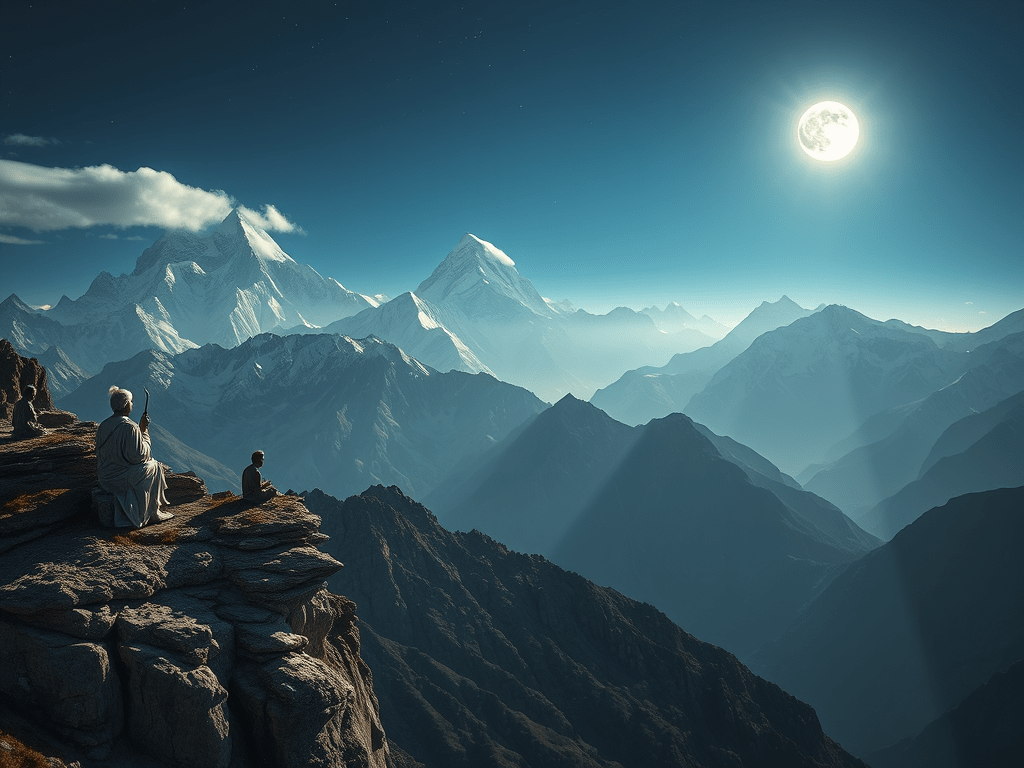
Long ago, before time even breathed, ancient sages perched on the bare cliffs of the Himalayas. Eyes closed, bodies still as stone, they meditated for centuries. Their souls burned with devotion until one night, the sky erupted. Their sacrifice fused with earth, air, fire, water, and spirit. This fusion shaped them into eternal mountains. Nanda Devi rose as their crown, Trishul gleamed as their blade, and Gangotri flowed as tears of their emancipation.
These peaks became a mother to humankind—lush valleys, icy rivers, forests’ embrace—a gift of nature’s love. But, their stillness was sacred. Disturb it, and the mountains unleashed fury—earthquakes, floods, and the shadow of doom.
The Call of Beeronkhal: My Quest
I was born in Delhi’s dust, a Garhwali by blood, with mountain whispers lingering in my dreams. Something pulsed inside me, deeper than blood, though I couldn’t name it—my tongue never learned Garhwali. Then one day, I set off for Beeronkhal, a hidden corner of Pauri Garhwal where the Nayar river sings. Villages dotted the shadow of Thalisain, pulling me closer.
Long ago, the Khas had roamed here—Vedic shepherds with bleating flocks. Rajputs followed—Rawat, Negi, Bisht—escaping Mughal blades to find shelter. But one mystery haunted me: “Panthris, who were they? “Pant” Brahmins fleeing Maharashtra’s fires or Varanasi’s holy banks? Or Panwar Rajputs, their journey ending here from Tehri’s strongholds? Some say their echo reached Punjab—a village called Pandher, where their story ripples, still. I went searching for the ancient souls who thrived in these hills. They gave me life in a village called Ghanshyali.
I feel the mountains watching me!
The Roots: Whispers of Fire
The tale begins in the 13th century, when Maharashtra blazed with chaos. Jaydev Pant, a Brahmin, clutched his sacred texts and fled with his kin. From Varanasi’s ghats, their path twisted toward the Himalayas. In Beeronkhal’s quiet, they built shrines and lit fires. But danger trailed them. One night, bandits struck—torches flared, intent on plunder. The Panthri’s fought back, and the ground shook—the mountains’ wrath. The raiders crumbled to dust, and the my ancestors survived. Their name, “Panth,” meant “path”—a trail carved in blood. Others whisper, they were Panwar Rajputs, warriors from Tehri, swords in hand. Their roots sank deep in Beeronkhal, but the truth about their history stayed veiled.
Children of the Peaks: Tribes Take Root
The mountains birthed more children. The Bhotiya emerged in snowy heights—Pithoragarh, Chamoli, Uttarkashi—trading wool and salt along Tibetan routes. The Raji hid in the forests—Pithoragarh, Champawat—known as “Vanrawat.” The Tharu thrived in the Terai—Khatima, Udham Singh Nagar—perhaps wanderers from Rajasthan. The Jaunsari danced on slopes—Dehradun, Chakrata. The Buksa rooted in jungles—near Nainital. Their lives sang with color—Bhotiya weaving, Tharu’s “Hori” steps, Jaunsari’s “Barada Nati.” But the trees fell, or the rivers were forced to change their course, the mountains roared. In 1803, Chamoli trembled—villages sank, thousand died. In 1894, the Alaknanda raged—a deadly flood. Nature’s anger or the sages’ curse? This is Uttarakhand—beauty and peril entwined.
The Weave of Survival
From ancient days, these tribes embraced simplicity as their way of life. In joy or hardship, their hands turned toil into art. Bhotiya wove wool carpets, a shield against the cold. Raji carved wooden figures, capturing the forest’s spirit. Tharu shaped bamboo baskets, bursting with life’s variegated hues. Jaunsari forged copper pots, their “Hansuli” necklaces shining. Buksa crafted mats, a testament to humble roots. In Beeronkhal, my ancestors left traces. If priests, they left a simple lota (a round brass vessel). If they were fighters, they left a lone sword. These items still ring through our clan. But these treasures faced threats. In 1790, Gorkhas swept in—temples burned, Beeronkhal’s calm broke. The mountains saw and sent floods—the invaders washed away.
A Trail that Leads to Punjab’s Punther
Did the Panthri’s were a sudden gust wind that drifted to Punjab, or did Punjab’s breath blow to these mountains? A village—Pandher or Punther—that still stands by the river Sutlej—may hold a faint echo of my Last name. Perhaps, some Panthri, worn by hardship in Beeronkhal, sought the plains. They became priests or soldiers. I am not too sure. In the 18th century, Gorkhas ambushed their path—steel clashed, blood spilled. The mountains watched and unleashed a deluge—the attackers vanished. The story of Panthri’s faded into a fog, but their name lingered. A few thousands still flourish across the globe.
The Diversity and the Risk
Over the past century, the mountains saw a shift—people descended to the foothills. Garhwali and Kumaoni settled the Terai’s more forgiving hearth. On the other hand, the plains brought newer voices—Punjabi drums, Bengali charm, Hindi’s depth—filling Udham Singh Nagar and Haridwar. Fields bloomed, markets buzzed. Bhotiya shawls now mingle with Bengali saris, Tharu bamboo laths blush in a Punjabi jatti’s hands. A fresh melody from the last hundred years, a canvas of diversity. Yet a question cuts through—am I one of them—the natives?
The 2011 census counts tribes at 2.89%. Some estimate 50-60% carry the native blood. But, when I look in the mirror, I see a face that could be found anywhere in India. Why, then, should I call myself Garhwali? For every Uttarakhandi scattered across the nation, the same twine pulls. Speak Garhwali or Kumaoni, and you are like a dry leaf on Dev Bhoomi’s behemoth of a tree. You are still blushing a fading shade of green. If you can’t, start the search for your roots all over again!
A Plea: Link in A Chain
I stand in Beeronkhal, wondering—does my name, caste, or lineage define my lineage as a mountain man—a pahadi?
It doesn’t matter. I won’t be the last strain to my roots in Uttarakhand. A threat looms—this tie is tenuous and could snap. We’ll vanish, and a piece of our shared history, our culture, will fade with us. I refuse to leave without a trace, not while I breathe. We may all disappear, but as long as memory endures, I won’t let future generations forget where they began. I won’t let them forget who they are—or who I am.
 Moon at Half Past Noon
Leave a comment