Chapter 4: Long Walk and a promise
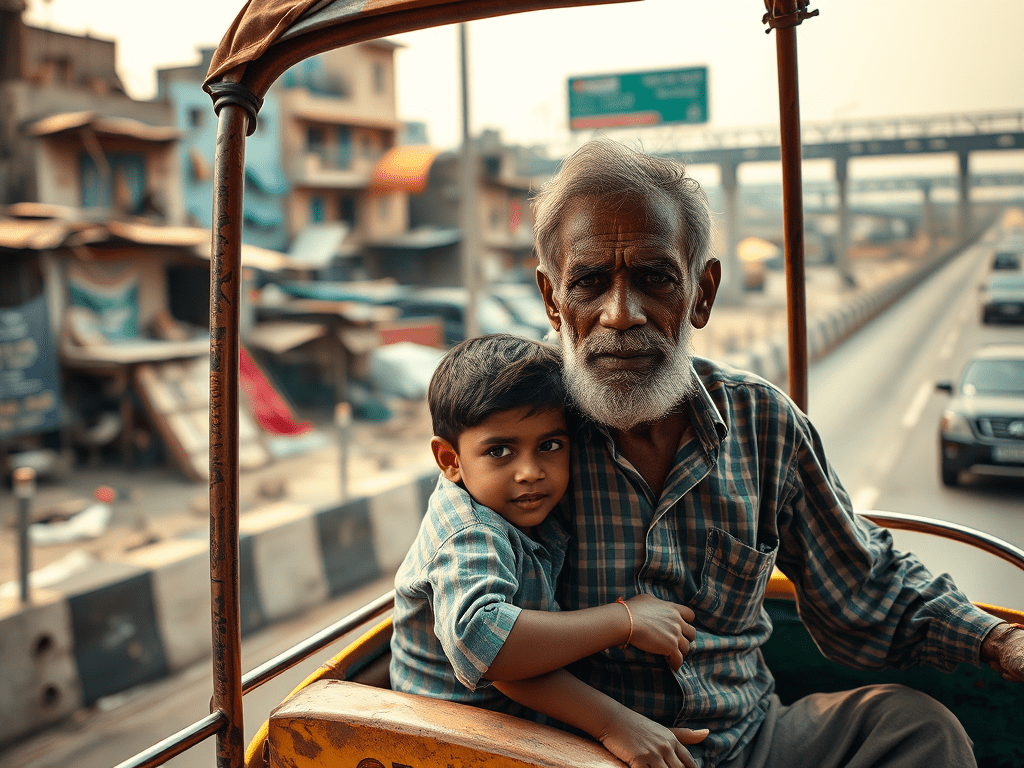
Matthu hoisted the sack from beside the splintered crate near Link Road’s crossing in Borivali West. He lurched into his first unsteady step. The cracked earth grated beneath his feet. He squared his chest with a stubborn jut. The old man led the way with a stoop holding his wife’s hand. Matthu followed. The sack’s bulk pressed into his back with a weight that felt alive. Its faint rustle prickled his spine like a whisper he couldn’t decipher. His pulse skipped, a nervous jolt flickered through his chest, and he wondered what stirred within its worn burlap. Their “worn ones” claim rang hollow against its stubborn mass. It was a lie he couldn’t swallow, not with that heft, not with that eerie sound.
The journey began as they crossed the signal at Link Road, a chaotic knot of Western Mumbai’s restless pulse. The city’s western edge—Borivali West—clung to its suburban bustle, a patchwork of middle-class grit and ambition. High-rises like his own gleamed with glass and steel just blocks away. Towering billboards loomed overhead—glossy faces peddled mobile phones and Bollywood dreams. The crossing veered eastward, peeling away from this familiar chaos. It led into a facade of posh promised land on every patch of rare green. Flyovers arched like steel spines. Metro trains glided above the fray into a crowded heaven of smoke and grime.
The old couple stopped breathless. The old man pointed to a climb an ugly mole of a hill. Matthu bent his knees and let the sack dropped gently. He sat on the road, huffing and puffing. He lifted his head and voice. He asked, “Where’s this home of yours?” His words had a sharp edge not enough to pierce bones and deaf ears. The old man rasped, “Only a little far. yet.” Afternoon prayers wafted along. The old couple bowed their heads, closed their eyes in surrender. Matthu seethed at this display of laziness. How could they? I am neither a slave nor a mule? His thoughts lacked the power to erupt into words of protest.
He shook his head helplessly, and then looked at the skies for an answer. A big bird barely drifted in the sky—a weird emoji for being stupid! That’s what I am. His gaze followed the lazy flight along the wall of a mountain of tins and tarp. He muttered, “Little or far?” The old woman rose from her pious meditation of gratitude and penance. She looked at the boy, he looked smaller and weaker now. “It’s god’s will, boy—most things in life don’t come easy.” The affection in her voice was masked by a severe bout of cough. The kindness on her face couldn’t escape the folds of her face. Matthu frowned and told himself, their answers dodged too much. He wondered if they were hiding something—perhaps, leading me somewhere bad.
They rose and made a slow hike up the notches on the sides of the beast. They stopped again at a corner. Matthu’s sight scurried along a dirty path, scanning the maze inside this mole hill. The crumbling walls rose close on either side. The buzz of traffic softened to a distant murmur. It was overtaken by the skitter of rats along the gutter’s stained rim. Tiny claws tapped a sinister rhythm against the concrete. The sour, festering reek of stagnant drains threading beside the path, gagged him. A sluggish pulse of filth seemed to watch him pass. His imagination flared wild and unbidden. He pictured a trap with thieves crouched in wait. The sack served as a lure to drag him off. The rustle sharpened, he told himself it was waking—shifting—and he imagined faceless shadows lunging from the gloom. He thought they’d snag me and toss me into that ditch! The drain gaped ahead. He told himself this better not be his end—right there!
The old man’s shuffle slowed Matthu’s pace. Each hobbling step dragged like a chain. Matthu’s legs burned under the sack’s weight. His breath grew ragged, sweat beaded on his brow, and exhaustion gnawed at his bravado. He scowled and thought this was too slow—too tiring! He snapped, “Hey—could you move faster or get behind me!” The old man turned; his glasses perched precariously on the tip of his nose. He rasped, “Behind—I will guide you.” Matthu nodded.
He thought it was better. He took the lead. He asked, “Tell me—left, or right?” The old man murmured, “Right—keep on.” Matthu veered right. The sack thumped again. His legs faltered as the weight dragged him down. It was heavy, then heavier. Exhaustion overtook him. He stopped. His chest heaved. He sat on a tin can. A loud voice boomed, “hey pest, keep moving on.” He rose. The sack thudded beside him. Toxic fumes puffed around like a shroud. He wiped his brow and thought he wasn’t tough enough—not yet.
The lane twisted further. Shanties sprawled below, a stark counterpoint. Some stood proud with tin roofs. Whirring air conditioners hummed a low drone. Satellite dishes perched like sentinels caught signals from worlds beyond. A motor bike gleamed beside a doorway with a fresh coat of paint. Matthu stared and wondered how they got rich here. Then, there were shacks that sagged in shame, pitifully. Tarp and cardboard trembled, vulnerable to gusts that could shred them into tatters. Desperation patched the walls. Filth pooled in ruts, where barefoot kids splashed through muck. Flies buzzed over heaps of refuse. A stench of indignity cloaked the air. The rawest wound of poverty lay bare. Matthu’s high-rise loomed in memory. He wondered how they lived like this? They lived split wide between tin wealth and tarp want.
Matthu’s rest stretched—his breath steadied—the sack’s rustle filled the air—and he told himself it was waking—watching! Fear surged. They’ll ditch me—snare me now! He pictured a trap hiding drums filled with acid. Thugs leaping and shoving him in that drain! He flinched and thought he should run—drop it—go! The old woman hummed a prayer—a frail, fractured tune. Her husband hushed her; sadness shadowed their glance. Matthu froze and wondered what that meant. Her gaze steadied him. He thought they need me. He asked, “Why’s this sack so heavy—what’s it hiding?” Suspicion edged his tone—he needed to know now! The old man rasped, “Old books that belonged to my granddaughter.” It didn’t make sense. Matthu scowled and thought they’re lying—Liars! Her hum broke. She glanced at her husband. Her frame trembled in grief. His hand lingered on hers. They embraced silence to subdue pain.
Footsteps shuffled—two shanty women approached, heads low—and one whispered, “Poor things.” Her voice trembled—tears gleamed—the other nodded. Matthu’s stomach knotted—Something awful—lost? One by one neighbours walked joined and greeted them in silence. A small procession of darkness followed Matthu. Prayers whispered woke up the small community from its indifference. “Please help the kid,” The old man barked a plea. A hand touched Matthu’s hand, “I’ll take it from here,” a middle-aged man looked at him. The stranger carried the sack easily in one hand.
Matthu was relieved. His imagination was stunned into silence. His body froze until old man held his hand. “Let’s walk,” his voice had the assurance of a grandfather. His wife now walked surrounded with the women, young and old, who had spent a life-time with her. They had shared much together. Sometimes by choice, but mostly they had shared these dredged of Mumbai—out of ill-will against their common enemy—there fate. The procession reached the old couple’s shack. It crouched at the shanty’s edge.
The shack was a frail huddle of tin and tarp. It slumped against a sagging wall of scavenged planks. Its roof tilted unevenly. Rusted sheets patched it. These sheets glinted dully under the dusk’s fading light. A single warped board propped the entrance. It was a crooked jaw barely holding. Mud streaked the base where rain had clawed at the earth. A tangle of frayed wires snaked from a neighbour’s shack. This hinting at stolen power. A cracked bucket sat overturned by the door. Its handle was bent. A thin wisp of smoke curled from a makeshift chimney—a punctured can wedged into the tin.
Matthu stared and wondered how anything stood here. It was a fragile shell amid the sprawl’s chaos. Tin wealth gleamed blocks away. Yet this clung to the ruins, bare and a mystery. The stranger who had taken the sack from Matthu stepped out. He took the old man’s free hand in his hands. He hugged him briefly and then left. Matthu looked at the scene, and then his hand in old man’s grasp. He could feel a cold comforting buzz in his palm. He knew he was safe. He was sad, and he didn’t know why. He felt weak but cared for. The old man’s fractured voice permeated the crowd, “we have had a long day. We have a life time to mourn.” He took Matthu inside and made him sit on a small cot in a corner. Matthu slumped.
After the ordeal of the last few hours, the hard rough wood felt surprisingly comfortable. He looked around this dim cave of warped tin and sagging tarp. The walls bowed inward under years of strain. A single bulb flickered from a frayed cord. It cast jagged shadows over a dirty floor. The floor was packed hard by countless steps, its edges crumbling into dust. The cot lay in the corner. Its thin mattress was sunken and stained. It was draped with a threadbare blanket patched in uneven stitches. Beside it, a chipped wooden stool held a dented tin mug and a cracked clay pot, coated in grime. The air thickened with the musty scent of old cloth. Stale smoke added to the mustiness. Stacks of yellowed papers—tied with twine—teetered against the wall, their edges curling like memories too heavy to hold. Matthu’s breath caught—this wasn’t a home, but a husk.
Matthu sat on the rusted cot in the old couple’s shack, its thin mattress sagging beneath him. He stayed silent, his gaze fixed on the dirt floor packed hard by years of footsteps. The old man stood near the warped tin door and broke the quiet. He asked, “Boy, do you want to eat?” Matthu didn’t answer—his lips pressed tight—and stared at the chipped stool holding an empty tin mug. The old woman shuffled over and eased onto the cot beside him. She lifted a frail hand and wiped his sweaty, dust-streaked face with a ragged cloth. Her touch was gentle, like Tarini’s after a scraped knee. Matthu could only stare at her lined face, eyes wide. She murmured, “Allah works in strange ways.” Her voice trembled with gratitude. She added, “He takes what’s dear and sends kindness when you least expect it.” Matthu blinked—her words sank in—but he said nothing.
The old man stepped outside, his slippers scuffing the threshold. The old woman sat still, her hand resting on Matthu’s shoulder, and her breath wheezed softly. Moments passed. The old man returned, clutching a broken tin can sloshing with water. He also carried a greasy paper cone of bhajiyas. The fritters were crisp and spiced. He set them on the stool and poured water into an old glass—cloudy, chipped—and handed it to Matthu. Matthu took it, sipped, and grimaced—the water tasted odd, metallic and warm—but thirst won. He drank it down and grabbed a bhajiya, chewing the onion-laced snack fast. He finished what they offered and sat still—alien tin walls flickered under a dim bulb—and said nothing.
The old couple watched him—his silence hung heavy—and exchanged a glance. The old woman leaned closer and asked, “Boy, why so quiet?” Matthu stared at the floor—his throat tightened—but no WORDS came. She turned to her husband and said, “Take him home.” Matthu muttered, “It’s far. Can we hire a taxi? I live in Hare Krishna building in Borivali West.” His voice barely rose above a whisper. He felt ashamed. He didn’t know why. The old man frowned, and the old woman’s eyes widened—they shared a puzzled look. The old man stepped outside again, his shuffle quickened, and returned moments later, sweat beading on his brow. He scoured a corner—lifting a cracked pot—and found a crumpled 10-rupee note. The old woman reached into a rusted can tucked near the cot and fished out another 10 rupees—creased and faded. They whispered—her voice shook, “It’s not enough, is it?” He nodded and murmured, “Abdul said, the minimum fare is 31. He would take 70. It is less than half of the normal fare.”
Matthu overheard their whispers. Their worry pierced his silence. He chimed in, “Puppa will pay when I get home.” His words cut the tension. The old man’s shoulders eased, and he looked at his wife. He said, “Wait for me.” She nodded, her hand lingered on Matthu’s shoulder, and the old man took Matthu’s hand—his grip bony but firm. They walked out, leaving the shack’s dim hush behind. The old woman sat alone. Her gratitude was unspoken. Her eyes traced the empty doorway.
Puppa will pay when I get home.
 Moon at Half Past Noon
Leave a comment