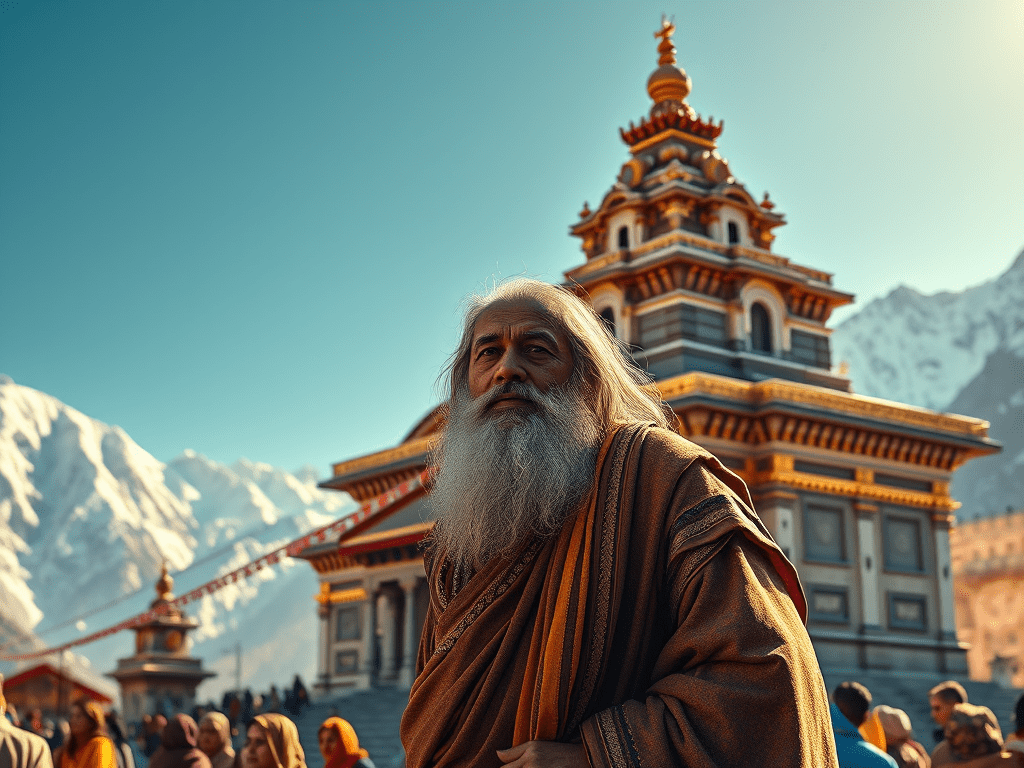
Adi Shankaracharya was a wise man from India who lived around 788 to 820 CE. He wanted to bring back old Hindu teachings and share his idea that everything is one, called Advaita Vedanta. He traveled to Uttarakhand, a mountain area in northern India, between 814 and 818 CE. Back then, Uttarakhand was a special place for spiritual people.
At that time, a family called the Katyuris ruled Uttarakhand. They started ruling in the 7th century and brought together two regions, Garhwal and Kumaon. They made Joshimath their main town and built temples for the gods Shiva and Vishnu, like the Jageshwar temple. They also made Badrinath, a temple for Vishnu, more important. This helped Shankaracharya with his work.
Shankaracharya walked through the mountains to Joshimath. There, he started a learning center called Jyotirmath to teach his ideas. The Katyuri king liked his plans and helped him, especially to bring back Hindu ways and reduce Buddhist ideas. Joshimath was a good spot because it was near two rivers, the Alaknanda and Dhauliganga, and close to Badrinath.
In Badrinath, Shankaracharya fixed the old Vishnu temple. He found a special statue in a hot spring called Narad Kund and put it back in the temple. He made rules for prayers that people still follow today. He chose a priest from his hometown in southern India. This priest was tasked with taking care of the temple. This tradition continues. Then, he went to Kedarnath, a big Shiva temple. He made the temple’s practices better and stronger. Some stories say he died there at age 32, around 818 CE, but not everyone agrees.
Shankaracharya’s visit changed Uttarakhand. He made it a key place for Hindu pilgrims by focusing on Badrinath and Kedarnath. Buddhism, which was popular before, became less common as he talked with Buddhist teachers and shared his ideas. People still visit these places today for a journey called the Char Dham Yatra.
The Katyuris became more respected because of Shankaracharya. They built more temples, and local tribes, called Khasas, started following Hindu ways. But later, by the 11th century, the Katyuris lost power, and new leaders like Ajai Pal took over. Shankaracharya’s work turned Uttarakhand into a strong Hindu area, leaving behind temples and traditions that lasted for centuries.
 Moon at Half Past Noon
Leave a comment