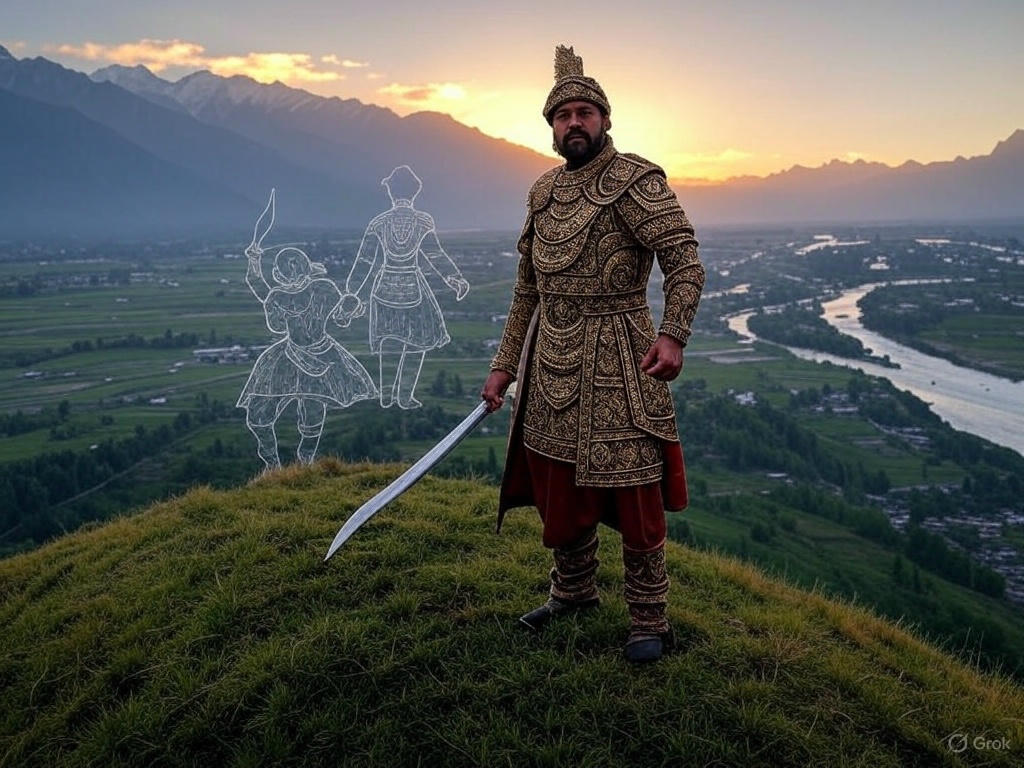
In the shadow of the Himalayas, peaks stabbed the sky. Meanwhile, rivers roared like guardians. Kumaon lay scattered—a land of ten forts. Each was ruled by a Garh-pati, a lord of stone and spear. The year was near 1500, and the hills whispered of war. Ajai Pal, a young king of the Pala line, heir to the fierce Khasas, stood on a ridge above Champawat. His dark eyes scanned the mud-brick walls below, bristling with spears. He would unite these forts or die trying.
The air bit cold, and the wind carried tales of the Garh-patis’ power. Champawat’s lord was Rudra Dev, a grizzled warrior. He held the old Pala seat. His fort stood like a squat beast by the plains’ edge. A hundred kilometers west, near the Kali River, Lord Bhimsen ruled Kali Kumaon. His garh perched like an eagle’s nest. It watched over trade paths to Doti. These two were the strongest—Rudra with his seasoned men, Bhimsen with his river wealth. Eight other lords—Bageshwar, Dwarahat, and more—clung to smaller forts, their spears sharp but their hearts divided.
Ajai Pal knew force alone wouldn’t win. “The hills are our shield,” he told his men, voice steady as stone. “We’ll use them.” His first foe was Rudra Dev. The old lord laughed when Ajai Pal sent a message: “Come feast with me atop the ridge. Let’s end this fight.” Rudra, proud and greedy, climbed with fifty spearmen, expecting tribute. Ajai Pal greeted him with spiced goat and millet wine, the night sky a blanket of stars. Laughter rang as Rudra drank deep, his men swaying by the fire. Then, with a nod, Ajai Pal’s warriors edged him to the gorge’s lip—a sheer drop into darkness. “Peace,” Ajai Pal whispered, and Rudra stumbled—or was pushed—his cry swallowed by the wind. The spearmen fled, leaderless, and Champawat fell by dawn.
Word spread fast—Ajai Pal was a fox, not a lion. Bhimsen of Kali Kumaon, hearing this, fortified his garh, spears gleaming along the cliffs. “He’ll never cross the Kali,” Bhimsen boasted, the river’s roar his moat. But Ajai Pal waited. One misty dawn, fog rolled thick as wool from the hills. He led his men—silent shadows—across a hidden ford, the river’s growl masking their steps. Bhimsen’s scouts saw nothing until arrows rained from above, piercing the mist. Stones crashed down, and the Kali swept away the fallen. Bhimsen, trapped, surrendered his fort, its walls no match for the fog’s cloak.
The smaller Garh-patis watched in fear. Bageshwar’s lord, a wiry man named Hari, sent gifts—wool and fish—to join Ajai Pal. Dwarahat’s ruler, old and tired, opened his gates without a fight. Eight others followed, their spears lowered. Ajai Pal climbed a new ridge—Almora—its high perch a throne of rock. He built a fort, walls hugging cliffs, a stronghold no foe could scale. “Kumaon is one,” he declared, and the hills echoed his name.
By 1400, the dust settled. Ajai Pal had welded Garhwal into a kingdom, shifting his throne to Srinagar, a riverbank hub where the Alaknanda gleamed. It was smart—trade flowed, defenses held. But here’s where the tale twists: some of those forts he conquered—or built—vanished, swallowed by earth, storm, or legend. Take Lohba Garh, near Pauri. Locals swear Ajai Pal seized it from a defiant lord, its iron gates—lohba—shining like a promise. Today, it’s a grassy mound, no trace left. Elders murmur of a landslide, a curse from a beaten rival’s ghost, burying it whole. No spade’s proved it, but the name clings like rust in the wind.
Then there’s Kali Garhi, up in Rudraprayag. Folklore paints Ajai Pal torching it after a chieftain’s betrayal—flames licking wooden ramparts, ashes scattering in a gale. Hikers stumble on charred pebbles, but the fort itself? A phantom—no walls, just whispers. Chandpur Garhi, his own seat, stands wounded but proud, its cracked stones a testament to his reign. Yet villagers spin a yarn of a hidden wing. They claim cannon fire from a foe collapsed it. Gold is said to be trapped beneath the rubble. Kids scour the ruins, but the earth guards its secrets. Badaun Garh’s another ghost—Ajai Pal razed it, lore claims, planting his flag on its bones. Now it’s a field, cows grazing where blood once soaked the soil.
Not all faded. Nagpur’s ruins poke through thorns. They are a shadow of its old might. Devalgarh’s temples—built under his eye—stand sharp. Their carvings are a Hindu hymn over Khasa echoes. Ajai Pal wasn’t just a conqueror; he shaped a realm. He welcomed Brahmins, reviving rituals after Buddhist whispers waned. His rule, stretching perhaps to 1420, fused Rajput steel with tribal roots. Modern Garhwalis carry that DNA. It is a mix of Khasa vigor and Kol resilience. Srinagar gleamed as his capital, a river city threading trade from Tibet to the plains.
But those lost forts haunt the tale. Did the Alaknanda’s floods claw them away, as it swelled in fury? Did rivals bury them in spite—earth piled high over broken pride? Or did time grind them down, leaving only Srinagar’s echo? Lohba’s iron gates, Kali’s scorched stones—some say spirits guard them still. At Chandpur, that hidden wing fuels treasure hunts; at Badaun, shepherds shrug over a flattened past. History’s hazy—dates wobble between 1358 and 1420, the Garhwal Rajvansh a patchwork of fact and fable. Was he 37th in his line, as lore boasts? No ledger confirms it.
Ajai Pal transformed a land of tribal tangles into Garhwal, “land of forts.” Kols painted caves while Khasas roamed free. Some garhs stood, some sank, but his mark endures. From Chandpur’s cracked walls to Srinagar’s river bend, he turned chaos to crown. Ajai Pal’s reign, with its vanishing forts, lingers like mist on the hills. It is a riddle of stone and story.
 Moon at Half Past Noon
Leave a comment