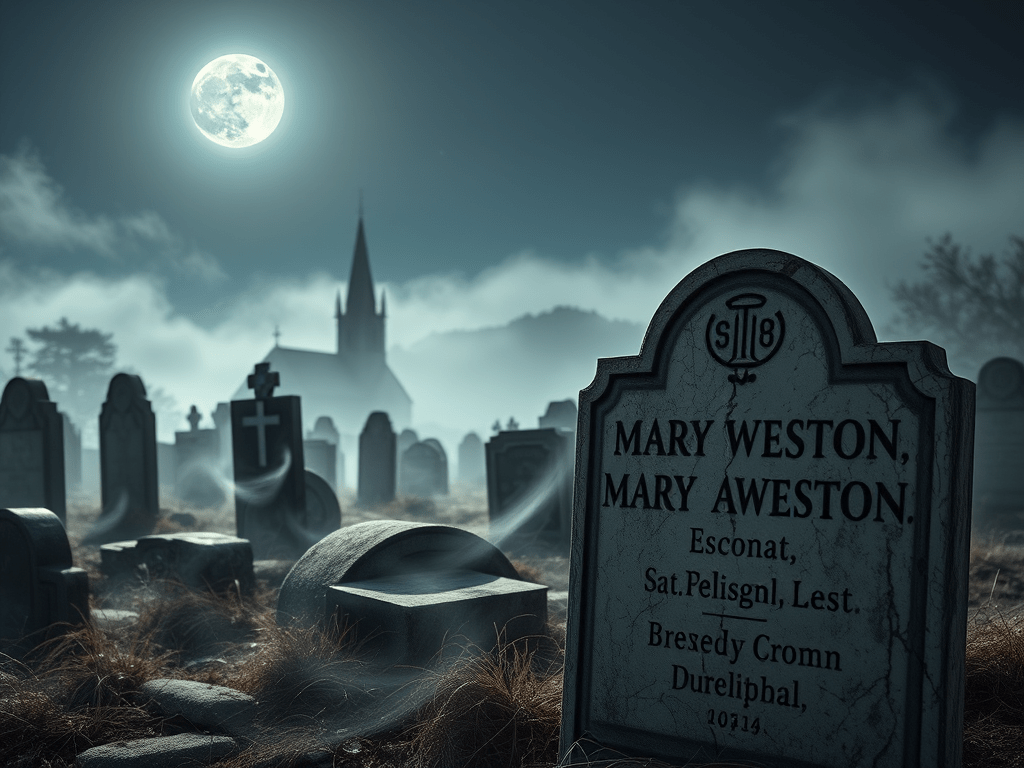
Under a Himalayan moon, where Solan’s hills cradle secrets in their pine-scented folds, the Dagshai graveyard lies hushed. Its weathered stones whisper tales older than the winds. Here, among the graves, shadows flicker. They are not mere tricks of light but echoes of lives that linger. These echoes are restless as the mist curling over the valley. The air hums with a quiet ache. It feels as if the earth itself mourns the souls it holds: British soldiers, Pahari villagers, and one Mary Weston. Her marble tomb, “Mem ki Qabr,” stands chipped and forlorn. Her unborn babe is cradled in eternal silence.
The churches—St. Patrick’s and St. Angelina’s—stand sentinel nearby, their spires piercing the fog, while the Army Public School’s laughter drifts like a fleeting hymn. This is Dagshai, where history and nostalgia weave a ghostly ballad, sung by spirits who never left.
In the 1600s, when Mughal hooves thundered through these hills, Dagshai bore a darker name: Daag-e-Shahi, “royal stain.” Criminals, branded with shame, were banished here, their fates sealed in the shadow of the peaks. The name softened over centuries, but the weight of judgment clung. By 1847, the East India Company claimed five villages. The villages were Dabbi, Badhtiala, Chunawad, Jawag, and Dagshai. They claimed them from the Maharaja of Patiala, Bhupinder Singh. They forged a cantonment atop a 5,689-foot hillock. The British, seeking reprieve from India’s heat, built a sanatorium for tuberculosis patients, their coughs mingling with the pines’ sigh. A prison rose in 1849, its 54 cells—dark, airless, save one “VIP” chamber with a fireplace—housing rebels and mutineers. The Gorkhas of 1857 left their marks. The Komagata Maru Sikhs of 1914 also left their marks. The Irish soldiers of 1920, including young James Daly executed by firing squad, left their marks as well. Bullet scars still pock the jail’s rear wall, now a museum where silence feels like a held breath.
The graveyard, overlooking the valley, cradles these histories. Mary Weston’s story haunts most vividly. In 1909, she and Major George Weston, childless and yearning, met a wandering sadhu who gifted them an amulet. Mary conceived, but joy turned to sorrow—she died in her eighth month, her babe unborn. George’s love was profound. He carved her a marble grave. The inscription was a vow: “To my wife Mary Rebeca Weston and our unborn Babe.” Locals whispered of miracles, believing a chip of her stone could bless barren wombs with sons. Piece by piece, the tomb crumbled under superstition’s weight, Mary’s spirit said to wander, guarding her desecrated rest. Some swear they’ve seen her at dusk. They describe her as a pale figure in white. Her gaze is soft but sorrowful. She trails the scent of lost hopes.
Beyond the graves, St. Patrick’s and St. Angelina’s churches stand as relics of empire. Built for British souls, their wooden pews creak with memory—hymns sung by soldiers’ wives, prayers for sons lost to war. St. Patrick’s, part of the Shimla-Chandigarh diocese, still holds Sunday mass, its stained glass catching the dawn like a promise kept. St. Angelina’s, smaller, feels more secretive, its walls echoing with forgotten vows. On quiet nights, locals say, organ notes drift from locked doors, a spectral choir praising the heavens. The churches, like Dagshai itself, straddle worlds—sacred and haunted, rooted yet adrift.
The Army Public School, perched on the cantonment’s edge, pulses with life, its cricket ground facing the valley’s sweep. Founded by Indian generals, it houses children of soldiers, their voices a bright counterpoint to the town’s stillness. Eighty percent are military brats, their days shaped by discipline and mountain air. Wooden dormitories are warmed by fireplaces. They glow with nostalgia for simpler times. Memories of chalk dust and shared secrets abound. Tales of “Mem ki Qabr” are swapped under blankets. Yet, the school’s cheer falters at twilight. Students claim shadows cross the fields. They see soldiers in outdated khaki who are marching to a drum only they hear. One boy, years ago, spoke of a man by the gate—tall, eyeless, whispering his name. The tale lingers, a rite of passage for new boarders.
Dagshai’s ghosts are not vengeful; they’re wistful, tied to a land that shaped them. The jail, where Mahatma Gandhi spent a night in 1920 to honor Irish mutineers, hums with their unrest. Visitors to the museum feel it—a chill, a tug at the heart—as if the walls beg for absolution. James Daly’s spirit, some say, paces the courtyard, his execution at 21 too abrupt for peace. The graveyard’s soldiers, buried far from England’s moors, watch Chandigarh’s lights flicker below, homesick for a shore they’ll never reach. Mary, perhaps, seeks her stolen marble, her love for George a tether to this earth.
Nostalgia blankets Dagshai like snow. For locals, it’s the scent of dham simmering at festivals. It’s the clack of the Kalka-Shimla train nearing Kumarhatti. It’s also the pride of a cantonment unspoiled by malls. For travelers, it’s the pang of touching history—fingers tracing a grave’s worn script, ears straining for phantom hymns. The hills remember monsoons when boys raced paper boats. They recall winters when church bells called the faithful. They also cherish evenings when whisky from Solan’s stills warmed officers’ tales. Even the ghosts seem to yearn. Their presence is a melody of what was. It is a lullaby for a town that refuses to fade.
Tonight, as Solan’s lights gleam and Himachal’s stars burn cold, Dagshai’s spirits gather. Mary drifts by her grave, her sigh blending with the wind. Soldiers stand at attention, their forms faint against the pines. In the churches, candles flare without a match. At the school, a dorm window shuts against no breeze. These ghosts linger not to frighten. They sing of love lost, duty borne, and a Himalayan nook. Here, time, like the mist, never quite settles.
 Moon at Half Past Noon
Leave a comment