
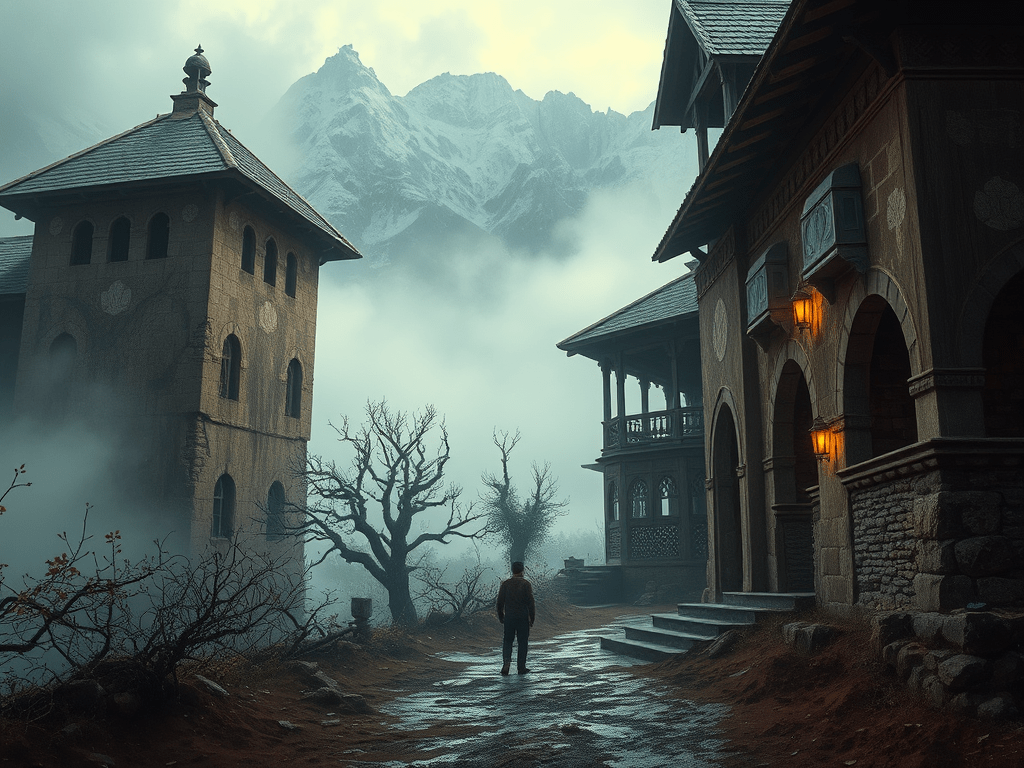
The Almora mountains loomed, their peaks veiled in fog like a ragged curtain. Mohan Sharma was a retired architect with a knack for pinching pennies. He trudged a muddy path, and his boots sank into the earth. He paused before a crumbling Kumaoni mansion that seemed to slump under its own decay. Its stone walls, chipped and gray, bore faded carvings of lotuses and Himalayan birds, eroded by relentless rain. He looked at the jaws on his expensive watch, closing in. The seller was late as he had promised. His body revolted by the tardiness of it all. He decided to explore the ruins.
Mohan prowled the grounds, boots grinding gravel, a naula breeze prickling his neck. His soles left mud for slick stone, treading the step-well’s ancient steps, now tangled with apple trees. He wasn’t sure if it was ruins of a bawri or an orchard. Gnarled roots split slate, clawing past a deodar arch, its lotus carvings worn like old scars. Below, murky ripples danced in the hollow, tracing a bride’s veil before fading. A rustle stirred the leaves—Banchari’s breath, the hill spirit of Kumaoni tales. Mohan shivered, clutching his solar lamp. “Ghost nonsense—just bad plumbing,” he muttered, stingy heart blaming the damp.
The rains gave this place a miss this season. He tried hard to shake of the clouds of messed up thoughts that engulfed him. The valley’s light glinted off ripples, a river winking through pines below. Mold clung to his jacket, the air heavy, urging him back to the kothi’s creaking shadow.
Inside, the mansion was worse, stubbornly holding on to it’s last breath. The main hall stretched wide. The floor talked back underfoot. The walls were damp with a smell like old books left in rain. A staircase, wood creaking, led to narrow halls where doors hung loose, their carvings of birds chipped away. Bedroom roofs hung dark and low, dust thick, cobwebs dangling like torn invisible shadows. On the top floor, an attic sprawled. It was stuffed with busted chairs and crates. A locked door caught his eye. It was carved with strange lines, maybe prayers. It felt warm under his hand and hummed faintly. “Junk,” he muttered, shaking it off, but the air was heavy, like someone stood close.
He stared at a jagar tapestry hung crooked. It displayed woven Kumaoni tales of spirits, mountains, and a red-sari bride with glowing eyes. Her threads glinted like the naula’s ripples. It felt heavy, as if watching. “Fancy rags,” Mohan muttered, but the air was tight, like someone stood close. Somewhere, a sagging cedar roof leaked. Dripping water reeked of damp earth. Dark, splintered wooden beams jutted out. They barely held three uneven floors. Each floor had a rotting veranda overlooking a naula—a sunken orchard where apple trees sprouted from an old step-well. Their gnarled branches tangled with roots and vines.
In a corner room, he lit a lantern, its cracked window showing the naula’s gnarled trees pressing near. The flame flickered, shadows dancing, and a scratching came—mice, he figured, in the walls. A shadow flickered and diappeared before he could give it a name. The cold sank deep, his breath fogging, and the naula’s ripples seemed closer, like eyes. The tapestry’s woven bride nagged at him. “Rubbish,” he spoke under his breath. Strangely he could hear himself long after his mind drifted into a waking dream.
He’d rebuild this mansion—new floors, cheap beds, a sign: Sharma’s Homestay. But as he lay on a dusty mat, the lantern dim, the mansion groaned, beams creaking like steps. The naula’s chill slipped in, a whisper he couldn’t name, curling tight around his dreams. “Ghosts of this haveli will make money, not trouble,” he mumbled. His stingy heart raced, the tapestry’s bride nagging. He drifted into this architectural maze. Startled by a hiss, his body jerked. The haveli creaked, boards groaning like steps. He wrapped a muffler around his neck and stepped out towards a broken path where he had parked.
Mohan saw a bargain—a decayed fixer-upper he’d patch into a homestay, cheap and profitable. He’d built Delhi offices years ago, outsmarting builders’ padded costs, and this mansion was his next coup. He’d built offices in Delhi years ago, always under budget, outsmarting builders who tried to slip extra costs. Money was his game, and he played to win. He had researched this remote place well. He knew his bargaining chip was a wandering ghost.
Baldev, the seller, wasn’t so sure. A skinny man with a face full of lines, he stood by the mansion’s gate, his hands shaking like leaves. “Five lakhs is what Thakur Vikram Singh had spent more than 50 years ago,” Mohan said, arms folded, voice firm. “That’s my offer—take it.”
Baldev’s eyes widened, his fingers clutching a worn cap. “Five lakhs? For this land, this haveli? Sir, it’s old as the British days—Thakur Vikram Singh had poured his heart into it!”
“You got it for free, Baldev.” Mohan replied. “Five, or I’m gone.” He leaned closer, his grin sharp, knowing Baldev’s nervous fidget meant he’d cave.
Baldev laughed, “City men know how to squeeze an apple when they see one.” His gaze darted to the orchard. Apples hung red, too bright against gray bark. “I didn’t want to sell,” he weighed his every word, voice low, as if the trees listened. Mohan didn’t budge, and Baldev’s shoulders slumped. He grabbed the envelope of cash. The notes were crinkled and warm. He hurried off. He muttered aloud in kumaoni, “Don’t come crying, when this cursed place shows you it’s belly. I warned you, you city slicker!” Mohan barely heard the warning.
Mohan ignored Baldev and started walking towards the path a few yards up. He thrust his hands inside his pockets searching for some warmth. His right hand clutched at a scrap instead. “Greed falls at Jatra,” the artistic hand looked beautiful. He read it again and again wondering how did it find it’s way into his pocket. There was no one around. He looked down at the haveli. He was baffled. He looked at the note one last time and dropped it.
As he walked closer to his jeep, he saw a crumpled figure. An old woman sat on a stone. Her shawl wrapped tight around bony shoulders, her cane digging into dirt. “You bought more than stone, son,” she said, her eyes piercing. “Thakur Vikram betrayed his bride here—she’s Bhootki, haunting that naula. Her songs lure you to the water. Do you hear it?” She pointed at the naula, its twisted trees swaying, muddy ripples glinting like eyes.
Mohan had hear all about it from his source. In Kumaoni lore, Bhootki was a betrayed spirit, her backward feet stalking old wells, singing eerie tunes. Mohan muffled a laugh. “I’m building a homestay, aunty, I will hunt down the ghosts.” His voice was brash, but her stare weighed heavy. He drove away. Villagers passing by—men with baskets, women with scarves—whispered, their words fading into the wind. Raju, Baldev’s nephew, lingered with a rice sack, voice trembling. “Uncle saw lights in the naula, nights no one came. It’s Bhootki.” Mohan’s 4WD kicked in, easily surfing over a broken path. His mind envisioning new place, and city guests with fat wallets. This mansion was his deal, and no tale would break it.


 Moon at Half Past Noon
Leave a comment