
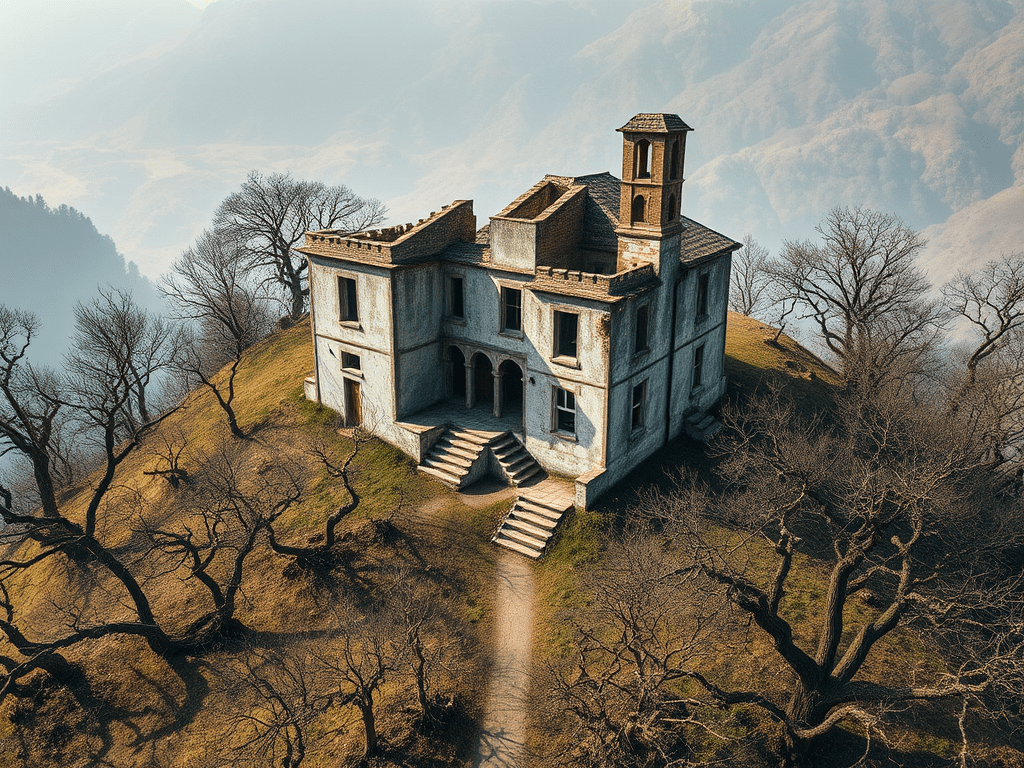
The Thakur Ram Singh Haveli sagged under Almora’s fading April light, scaffolding clinging to its scarred, chipped walls. Mohan, a whirlwind of shouts and cajoling, focused his morning ire on Damu, a gaunt laborer in the naula orchard. “Donkey! Stop your ghostly wandering and work!” he bellowed. Damu, bone-pale, sharpened a chisel with slow, deliberate scrapes, his vacant stare lost in the gloom. He murmured “Anjali…” before melting into the pines. A half-empty pina bottle lay at his feet. His chilling aura and glinting eyes were unsettling.
Urgent renovations, a costly beast Mohan wrestled with cunning, pulled him away from pursuing Damu. Days into the project, laborers demanding 500 rupees daily either idled or vanished, their shoddy work—misaligned beams, cracked plaster—mounting expenses. Splintered deodar, crumbling local stone, and clumped cement strained his finances. Transportation costs were exacerbated by Almora’s treacherous roads, where mudslides snapped axles and pine debris choked paths.
The haveli seemed to resist with a malevolent will that went beyond mere decay. Rusty muck erupted from the pipes in the guest rooms. It coated the once-elegant wallpaper in a slick, brown film. The film smelled of rot and ancient secrets. In the grand hall, a massive slab of the ceiling crashed down with the force of a thunderclap. It narrowly missed a group of workers. They were huddled around a sputtering generator. Outside, Naula roots, thick as pythons, writhed and snapped at the workers’ shovels. The earth itself seemed to reject Mohan’s intrusion. Their pale tendrils glistened with a strange, unnatural moisture. Bhootki rumors spread among the terrified laborers. Lila’s dramatic pronouncements fueled tales of milk-curdling songs that froze the blood in their veins. Shattering eardrums left men deaf and trembling. They were convinced the vengeful spirit was displeased by the renovations.
Mohan shrugged off Damu’s lurking presence. His eyes were fixed on the cracked wall. He was calculating the cost of repairing it with a roll of blueprints. He was already mentally subtracting the cost from his projected profits. “Three hundred rupees is more than they’re worth,” he muttered. He slashed wages. He hired the most desperate villagers he could find. They were men with hollow eyes and women with shoulders bowed by hardship. They knew they were in no position to argue. He bartered for salvaged timber from a collapsing barn. Some of it was rotten and infested with woodworm. He hauled free riverbed stones that crumbled easily. He stretched defective cement with ash. He ignored the way it crumbled in his hands as if it was sand. Donkey carts were overloaded with cracked but usable supplies. They navigated the monsoon-soaked paths. Their precariousness made even the drivers nervous. “Keep the naula creepy,” Mohan ordered the foreman. He rigged a flickering lamp to cast long, dancing shadows on the water and twisted trees. He deliberately turned Bhootki’s curse into a potential profit-generating tourist attraction.
Yet, the persistent, faceless Damu irritated him most. Damu was a constant presence in his periphery. This was unlike the transient laborers. They fled at the slightest provocation. It could be a broken tool, a sudden gust of wind, or a particularly vivid retelling of a Bhootki legend. At first, Mohan barely noticed the new laborer, another gaunt figure in the line of desperate men seeking work. But as the days passed, he began to stand out. He was surprisingly strong for his age and never complained. His movements were fluid and tireless. He worked from dawn till dusk, hauling stones twice the size of other men. He wielded a pickaxe with the vigor of a man half his age. But his eyes, Mohan noticed with a growing unease, held an ancient weariness that belied his strength. It was as if he carried the weight of centuries within him. He often stared at the haveli with a strange intensity. When he asked about Damu, Mohan spoke casually to his fourth contractor, a man named Jairam. But Jairam only shrugged and gave a nervous glance. “Strong back, Sharma-ji. Doesn’t talk much. Says he’s from… from far away.”
Eight months into the freezing December renovations, Bhootki fears had driven off fifteen laborers. This cost 270,000 rupees monthly in wasted work. Defective materials totaled 150,000 rupees, and landslides delayed shipments worth 60,000 rupees. Savings halved to 500,000 rupees, Mohan further cut wages and managed the subtly sabotaging “Damu” with menial tasks. Resourcefulness – recycled materials, ingenuity – saved him 100,000 rupees. Despite rising walls, leaks and cracks remained. Exploiting the Bhootki legend with rigged lamps was his strategy. The once unsettling “Invisible Damu” now offered a strange comfort amidst the ruins.
Curiosity about this spectral presence finally overwhelmed Mohan, yet Damu was elusive. Sniffing the air, trudging muddy paths, his tightfisted heart still ached at the project’s cost. The naula’s fading ripples resembled a bride’s veil, a stinging bichhu ghas breeze on his neck. “Ghost nonsense,” he muttered, envisioning his plan: flickering lamps, creaking floors, marketing Bhootki to thrill-seekers. Another year, and this haveli will be a goldmine, he thought. Finally spotting Damu’s shadow, he followed him into the naula, heart pounding. “Lazy fool!” he yelled, tripping, his shove against a crate igniting a scuffle. Tools clattered. Shuffling feet behind him. A freezing, vacant stare. Ramu’s spade-like hand moved, and Mohan was paralyzed. Cold fingers brushed his arm. Blazing eyes whispered, “Anjali…” Mohan’s vision blurred, and he fainted, waking alone to dripping sap from a rudraksha mala. Ramu had vanished, never seen again, workers whispering Bhootki’s milk-curdling, eardrum-shattering songs. Strangely, Mohan had no recollection if this incident or if Damu ever existed.
Six months before opening, January 2024’s frost veiled the haveli, a near-complete homestay haunted by its past. The grand hall gleamed with polished stone floors. Lotus arches framed a reception desk. Creaking cedar beams whispered Bhootki’s songs. They curdled milk and shattered eardrums. Twelve guest rooms, plastered and wired with flickering lamps, lined two floors, their cedar floors creaky, naula-facing windows cracked. A first-floor lounge held jagar tapestries, red-sari brides glinting, while the attic, with eerie carvings, stored debris. The naula orchard, vines cleared, apples glinting, led to a step-well path rigged for scares.
Villagers saw the old haveli’s kath-khuni facade. Raju and chaiwallahs admired the lotus walls and naula’s roots. They whispered of Bhootki’s bride. Her spirit was undimmed by plaster.
Mohan needed help – strong and pliable, or his wallet would suffer. The village offered a chaotic opportunity. In the square, a crowd surrounded Dharma. He was a bruised, scared, skinny man pressed against a cart. His voice was thick with a distant accent. He pleaded innocence against Pratap’s accusations of staring at his wife. A mix of angry and uncertain mutters rippled through the onlookers.
Carrying a cement sack, Mohan groaned at the village drama. But Dharma’s fear echoed his own early insecurities. Dropping the sack in a puff of dust, he pushed through. “What’s happening?” His hard voice cut through Pratap’s sneer: “This outsider bothered my wife. Stay out, city man!”
“Anyone see it?” Mohan’s gaze flicked to Pratap’s wife, her averted eyes and tight scarf suggesting a lie. His gut churned – Pratap wanted trouble or money.
“I’m buying half this village’s supplies,” Mohan declared, standing tall. “Mess with me, your shop’s done.”
Pratap’s fist lowered, his face sour as the crowd shifted back. Raju, Baldev’s nephew, muttered, “City guy’s tough.”
Dharma bowed, trembling. “Thank you, sir. I owe you everything.”
“Save it,” Mohan waved off the gratitude. “Can you fix things – walls, pipes?”
“Anything,” Dharma’s eyes brightened. “I built houses in Nepal, fixed carts, grew vegetables.” His voice softened with a memory of his lost village. He remembered a sparkling river and his mother’s fire-ravaged garden. It was a loss he wouldn’t name.
“You’re hired – low pay, no complaints.” They walked towards the mansion. The villagers watched as Raju whispered to a chai seller, “That Nepali’s working the bad place now.” Dharma slowed, his gaze drawn to the orchard’s fire-red apples.
As they walked, Dharma muttered in Nepali. Mohan stopped, breathless, demanding he speak Hindi. Dharma gestured downhill with suppressed excitement, and Mohan, bemused, quickened his pace.
The village buzzed about Simran. Raju told weavers that Bhootki had lured her to the naula. She sang from the ripples like a vengeful bride with fiery eyes. His aunt’s jagar confirmed this tale. Lila the sweeper echoed tales of Banchari’s chilling sighs. Bhootki’s songs and Banchari’s breath were woven into the lore of Uttarakhand’s forests and naulas.
“Sir, this land feels heavy,” Dharma murmured. “My grandmother told of houses holding anger. We should pray, burn herbs.”
Mohan snorted, kicking a pebble. “Prayers cost money, Dharma. Work’s the only plan.” They reached the path above the mansion, stars twinkling overhead. A sudden draft chilled Mohan, the orchard’s cold coiling around him. Exhaustion hit, and he gasped for air, hurrying inside, blaming the wind, switching on his few Delhi-bought solar lamps.
Dust filled the mansion’s grand hall, broken tiles crunching underfoot. Mohan showed Dharma the cracked walls. “Fix these cheap – use old wood if you can.” Upstairs, narrow halls led to loose doors with chipped bird carvings. A damp, dark room with a window facing the encroaching, rustling orchard made him mutter, “Rotten place,” his chest tightening.
Outside, checking supplies, Mohan grinned at his shrewd bargains. As fog thickened, a huge shape moved. He froze, grabbing a stick, heart pounding. “Stay back!” It was a bear-sized dog with shaggy fur and glowing eyes.
Dharma knelt, offering a carrot. “He’s a friend, sir. Bhoot – came from the fog.” The dog ate calmly, tail wagging, a deep growl fading. Embarrassed, Mohan lowered the stick and stifled a gasp. “That thing, it would eat more than my budget!” he snapped, still jumpy from Bhoot’s drum-like bark.
“He likes vegetables,” Dharma smiled, tossing another carrot. “Maybe monks trained him. I’ll grow his food.” He whistled, and Bhoot sat, guarding Dharma with intense eyes. Surprised by the dog’s docile behavior, Mohan grumbled, “If he destroys anything, you’re both out.” Bhoot barked, making Mohan flinch. “Keep him quiet!” he muttered. Dharma’s smile held a spark, as if he saw something significant in Bhoot.
They worked late, Dharma fixing the shed’s wall, new hinges gleaming under the solar lantern. The moaning, singing orchard seemed to beckon. Bhoot stayed by the gate, eating Dharma’s seemingly endless supply of greens. He never approached the trees. His low growl was fixed on the apples. The cold hung heavy. The orchard rustled with roosting birds. As they locked up, the attic door inside creaked open a sliver, its tapestry eyes glinting from strange carvings. Unseen by Dharma, Mohan’s face tightened, the mansion’s shadow deepening under his eyes.
 Moon at Half Past Noon
Leave a comment