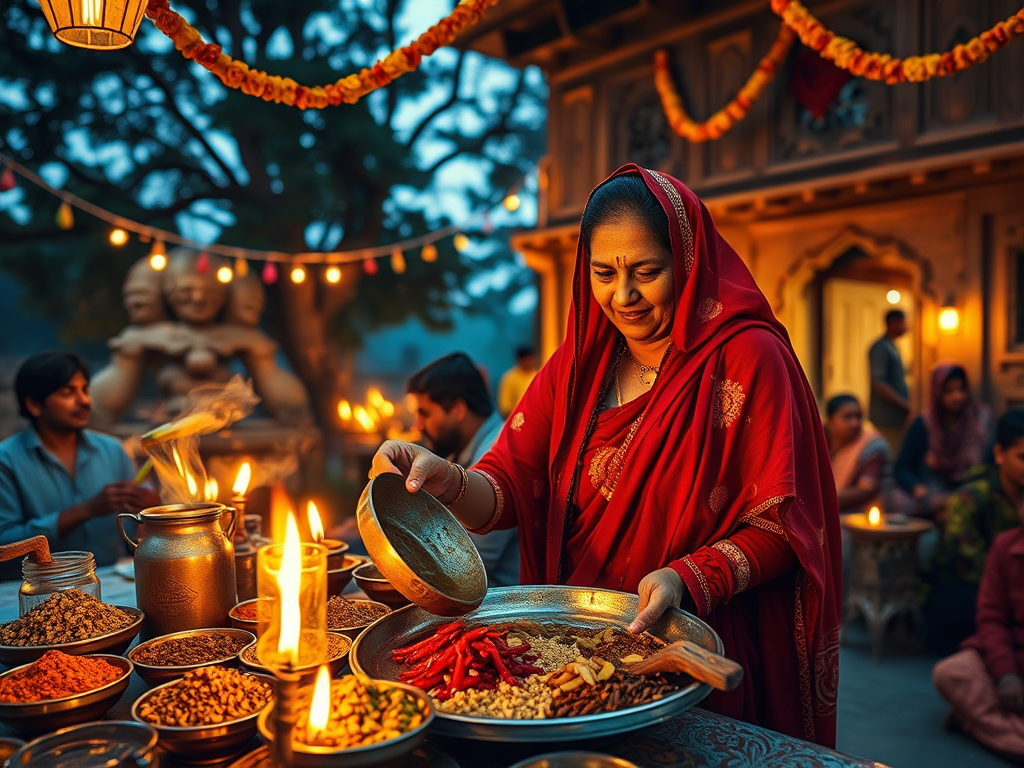
In late July 2024, a monsoon breeze swept through Almora’s hills, carrying the vibrant hum of the Harela festival. Thakur Ram Singh Haveli stood tall, its kath-khuni walls of stone and polished cedar gleaming under the sun. Lotus carvings shimmered, as if Anjali’s Bhootki ghost lingered in their shadows. Mohan Sharma’s homestay, finished after months of tight-fisted planning, was ready for the Singh family, due tonight. A dholak’s loud beat filled the courtyard, joined by the spicy aroma of bhatt ki churkani and aloo ke gutke. Marigolds hung between deodar trees, yellow petals glowing in oil lamps. The music echoed off the haveli’s stone facade, its wooden supports warm and earthy. Almora’s slate roofs sparkled below the Himalayan foothills. SUV engines rumbled faintly, hinting at city guests chasing Harela tales, but the feast’s noise drowned them out.
The courtyard buzzed with villagers, their voices weaving laughter and chatter. Copper plates clinked as people scooped up steaming black soybean curry and spicy potatoes. Tables were draped in red and gold woven cloths, Harela’s harvest colors. Oil lamps flickered on stone pillars, casting shadows that danced across lotus carvings. The naula orchard stretched behind the haveli. Its red apples were glinting. A stone path wound through it, rigged with hidden lights for Mohan’s spooky Bhootki scares. The grand hall was open to the feast. It shone with polished mosaic floors and solar chandeliers. This design was a blend of luxury and thrift from Mohan. Women sang Kumaoni lullabies. Their voices were soft under the dholak’s rhythm. Meanwhile, elders wove marigold garlands for Bhootnath prayers. This was to honor the harvest.
Krupa glided through the crowd, her red scarf with gold threads catching the light. She served spicy chutney, her moves smooth but sharp. Her eyes sparkled as she leaned toward Elder Ganga Ram, a wiry man with a gray beard. “This chutney’s special, Ganga-ji,” she said playfully, spooning a dollop. “Picked under Harela’s moon—makes you dance!” The crowd chuckled, plates clinking. Krupa’s smile faded. She glanced at the haveli’s lotus carvings. Her thoughts turned to a Thakur who fled to Shillong after Anjali’s death. He was hiding among Khasi traders. Her knife, etched with Shillong’s Khasi runes, glinted—a relic from her husband’s killer, a Thakur she’d tracked to Almora. Bhoot, the scruffy dog, sniffed the blade, his dark eyes wary, then growled at the orchard. His nose caught a frayed rope fragment near Anjali’s tree, its tight knot strange. A shadow moved, muttering “Anjali…”—Damu’s shadow, unseen in the feast’s din.
Dharma sat cross-legged on a mat, nibbling kafal berries, their sweet-tart bite cutting the curry’s heat. His lanky frame leaned forward, eyes on the orchard’s swaying apples. He hummed a Kumaoni lullaby, soft and mournful, for his sister, lost to a Vanachari spirit’s fire in Nepal. Her screams haunted him. He gripped his salt pouch, grains spilling as he whispered prayers against spirits. Krupa leaned in, her voice sharp with irony. “Dharma, your salt’s scaring Bhootki more than my chutney!” Bhoot sneezed, pawing salt-dusted ground, his growl low. Prem, a stocky villager with a red face, tipsy from pina, cackled, “Keep sprinkling, Dharma—spirits’ll trip!” The crowd laughed, marigolds flying. Dharma’s eyes narrowed, his voice firm. “Salt saves souls, Prem, not your jokes.” Bhoot’s growl deepened, his nose fixed on the orchard rope.
Villagers sprawled under deodars, sharing stories. They spoke of boars tearing fields, their eyes bright with mischief. The river’s lights twinkled below, called “Anjali’s tears” for her sad death. A boy bragged of seeing a tall spirit, eyes like coals. “Your eyes see curry dreams!” Prem shouted, banging his plate, Kumaoni words sparking laughs. Women wove garlands, singing Harela songs, while elders like Ganga Ram chewed betel leaves, nodding at tales. The feast swirled with color, but the orchard’s shadows loomed, heavy with Anjali’s presence.
Mohan stood amid the chaos, sweaty in a plain kurta, his calm fraying. He perched on a wobbly platform. He clutched a faded letter from his brother. His brother had mocked his dreams before hanging himself over debts. A Shillong postcard slipped out, its Khasi script hiding a Thakur’s crime—a killer’s name from Anjali’s time. The Thakur had fled to Shillong after her betrayal, scribbling secrets in Khasi script to hide from Almora. Mohan’s brother found it, a truth that broke him. Mohan shivered, shoving it back, the haveli’s lotus carvings looming like judges. His PowerPoint—blurry photos, shaky clips—was his plan to debunk Anjali’s Bhootki for the Singhs. The village, led by Ganga Ram, demanded a ₹20,000 puja with a goat, or they’d block his homestay. Mohan’s stomach churned.
“The haveli’s history!” Mohan shouted, his voice cracking as the projector hummed. “Kumaoni tradition, not ghost stories!” A blurry haveli photo flickered, then a distorted wall. “Anjali’s death? Sadness, bad air!” Villagers coughed, skeptical. The projector flashed Mohan in a shiny pagri, feathers popping like a silly bird. “Sharma-ji’s pagri scared Bhootki!” Ganga Ram hooted, the crowd roaring, petals flying. Laughter faded as a slide showed Mohan’s brother, eyes wild, laughing over whiskey, frozen before his death. A villager yelled, “Rope!”—a ghostly noose in their minds. Mohan froze, stammering, “Bad air… science…” Krupa smirked, her voice biting. “Nice slides, Mohan—ghosts must love them.” Mohan glared, stung. “Keep your chutney tricks!” The crowd chuckled, sensing her sarcasm.
Radha, an old woman with hennaed hands, stood, her voice dropping low. “River lights shine—Anjali’s tears, crying her Thakur’s betrayal.” Villagers fell silent, eyes on her. “Your feast, Ganga, stirs her pain, hurting our crops.” Her gaze pierced Mohan. “Bhootnath’s stories light the valley, not your slides.” The dholak paused, her words heavy. Mohan stammered, “Light bugs…” Radha snapped, “Bugs don’t cry!” Ganga Ram stood, his voice loud. “Bhootki’s anger stirs boars, tearing fields! Your homestay woke her!” His stick hit the ground. “A goat puja, full moon, ₹20,000, no debate!”
Mohan spun, nearly falling. “Boars love your curry scraps, Ganga-ji, not my haveli!” He grinned cheekily. “I’m their haunted cook!” Villagers laughed, the dholak resuming. Krupa snorted, “Cook? You’re Almora’s cheapest caterer!” Bhoot grabbed a curry scrap, scattering Dharma’s salt, hiding rope tracks. Dharma yelped, “Bad luck!” Prem tossed a marigold, hitting Mohan’s pagri, petals sticking like glue. “Curry for boars, Sharma-ji!” he cackled, plate banging, the crowd roaring.
Dharma muttered, “Spirits laugh,” salt dusting Bhoot’s fur. Krupa teased, “Your salt’s spicing Bhootki’s feast!” Bhoot sneezed, Prem laughing, “Spirits’ll trip!” Mohan hissed, “My haveli’s no boar kitchen!” His eyes flicked to the orchard, Bhoot’s nose buried in the rope, a chill hitting him. His rudraksha mala felt heavy, whispering “Anjali.” Krupa’s knife, from Shillong, matched the postcard’s strange script, a clue to her husband’s killer. Damu’s shadow, seen in Shillong, followed the postcard to Almora.
The projector froze on his brother’s grin. Villagers jeered, Prem banging his plate. Mohan’s hands shook. “Free pina—no puja!” he shouted, desperate to save his loans. Krupa’s grip tightened, her Thakur grudge warring with pity. Her smile hid a vow to find the killer. Dharma eyed Krupa, fearing betrayal like his sister’s, his lullaby fading. “Your slides are magic,” Krupa said, sharp, “but they won’t pay your debts.” Mohan shivered, Bhoot’s growl chilling the feast. SUV lights cut through the deodars, signaling the Singhs’ arrival, as the haveli’s fountain sparkled, ready.
 Moon at Half Past Noon
Leave a comment