
Curse of the Crimson Apples
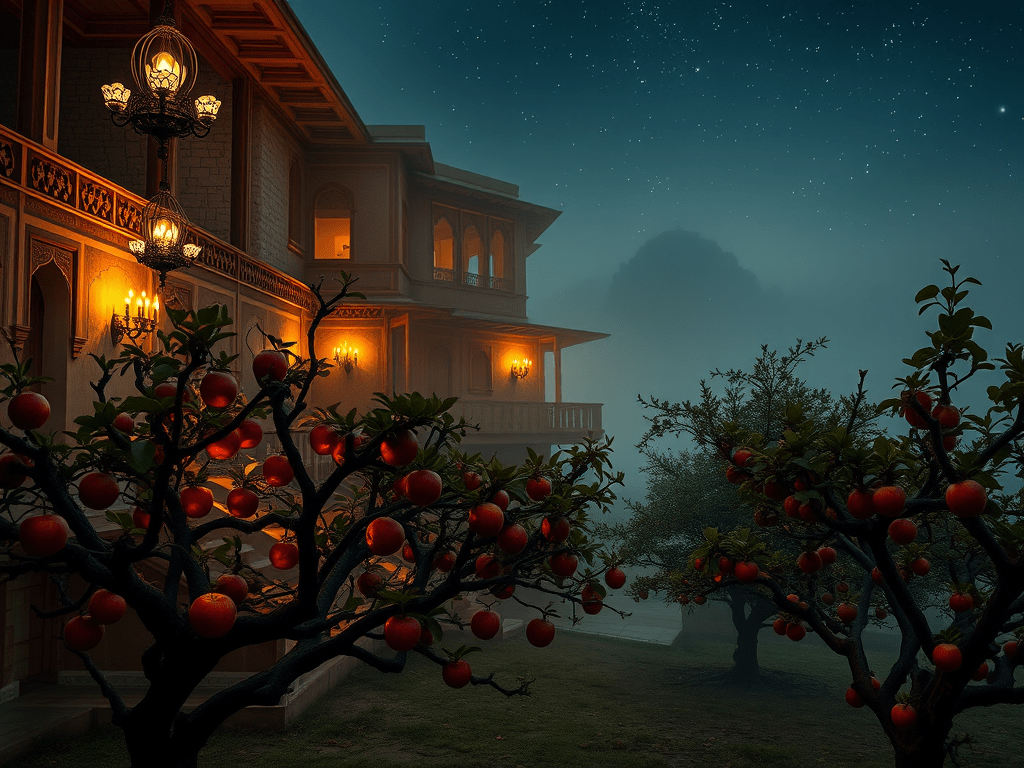
In early August 2024, a week after Almora’s Harela festival, a soft monsoon rain cloaked the Thakur Ram Singh Haveli. It wrapped the haveli in a shimmering veil. Its gentle cadence was a lullaby on the slate roofs. The haveli stood as a sanctuary of timeless beauty. Its kath-khuni walls—stone woven with polished cedar—radiated warmth. The marigold-lit tapkeshwar chandeliers cast a golden glow. The intricate lotus carvings curled along the beams. Their petals shimmered like whispered dreams. They cast delicate shadows on the cedar floors. The floors were smooth as glass and fragrant with wood oil. Beyond the porch’s arched glass, the naula orchard’s apple trees stood in quiet reverence. Their gnarled branches cradled crimson apples that gleamed like rubies in the misty dusk. A starlit sky framed them, piercing through parted clouds. The apples bloomed year-round against nature’s rhythm. They glowed with an eerie light. It was as if Anjali’s 1880s murder fed their roots. Her Bhootki curse was defying the seasons. A cool breeze slipped through. It stirred a rudraksha mala dangling from a chandelier. The beads whispered “Anjali…” as silk grazed the floor. It was a faint murmur in the haveli’s serene embrace.
Dharma stood by the lotus fountain, polishing its carved petals, the water’s ripple catching starlight through the atrium’s glass. Bhoot was beside him. His coal-black eyes were fixed on the orchard. The crimson apples shimmered unnaturally. Their constant bloom was a mystery that gnawed at Dharma’s soul. “Why do these apples bear always, defying seasons?” he wondered. His Nepali accent was thick. His thoughts drifted to Anjali’s curse. Her blood-soaked murder by the Thakur stained the soil. “Her spirit feeds them. It keeps the crimson fruit ripe.” he murmured. Bhoot’s low growl echoed his unease. The apples glowed like accusations under the mist. Their eerie light was a testament to Anjali’s wrath. Yet, village whispers tugged at him. Lila shared tales of the naula’s magic soil. Its spring-fed richness tricked trees to fruit beyond autumn. The orchard was cradled in eternal bloom by its unique microclimate. “Her curse, or the naula’s secret?” he mused, Bhoot’s ears twitching, a fourth soul’s whisper brushing the air. The orchard’s beauty was haunting. Misty branches contrasted with starlit crimson fruits. It was a tapestry of curse and calm. This tied Dharma’s guilt over his sister’s fiery death to the haveli’s shadowed past.
Mohan Sharma sat in the grand hall. His calloused fingers traced the guestbook’s worn leather. A weary smile flickered at a note pinned above the mosaic tiles: “Best stay, spooky fun! Booked for next year!” The Singh family—teens Vikram, Meera, Tara—had departed days ago. Their #NandaDeviHaunt video soared to 50,000 views on X. It flooded his inbox with inquiries. “Viral gold!” he murmured, but torrential rains had closed the Almora-Bageshwar road, choking bookings to a trickle. The hall was a vision of elegance. Its tiles reflected lotus carvings. The marigolds cast a warm haze. The air was sweet with bhatt ki churkani drifting from Krupa’s kitchen. Mohan’s homestay dream, sparked after his brother’s suicide over haveli debts tied to a murky Shillong secret, teetered on triumph. Yet, guilt gnawed—his brother’s last words, “You’ll sell our soul!”, haunted him, whispers of a forged will fueling his paranoia. Had he betrayed his kin for this cursed ambition? Bhoot’s growl echoed from the fountain, and Mohan shivered, the orchard’s crimson apples glinting beyond the glass.
A worn package lay on the desk, delivered from a Delhi bookseller. Mohan had ordered it online. He did this after exploring the Thakur’s Shillong connection. The book, titled Killer of Shillong, had a cover etched with faded Khasi script and crimson stains. It detailed a 19th-century murderer’s trail of blood. He tore it open. The pages were heavy with tales of the Thakur’s crimes. They recounted Anjali’s strangling and poisonings masked as herbs. There was also a flight to Shillong’s shadows. “His secrets,” Mohan whispered, heart racing, the book’s runes matching his postcard’s scrawl. Was this the killer who drove his brother to the rope, debts tied to a forged will? The orchard’s crimson apples glowed outside, their unnatural bloom—fed by Anjali’s curse, or the naula’s soil?—mirroring the book’s bloody imagery. Krupa’s shadow flickered in the doorway, and Mohan jumped, the book thudding to the floor. “You’re the one to say ghosts don’t exist!” she teased, her laugh sharp. “You jumped like you saw Thakur’s ghost!” Mohan’s face reddened, “You loud mouth! Don’t ever sneak up like that—anyone would be startled!” Krupa smirked, “Big talk for a jumpy cheapskate!” Bhoot yipped from the fountain, the hall’s marigold glow softening their banter, the lotus carvings whispering calm.
The village hummed with whispers, muted by the rain’s hush, as if Almora exhaled a secret. Raju, sipping pina with chai sellers under a dripping awning, murmured, “Sharma-ji’s haveli’s a city hit, but Anjali stirs!” Lila, sweeping the porch, her broom whispering against wet stone, nodded, “Simran saw Bhootki’s face in the naula—blood!” Their tales wove Anjali’s murder—“Thakur killed her, fled to Shillong!”—stirring unease among passersby, their umbrellas bobbing like fireflies. Mohan haggled with a quilt seller by the gate, “Ten rupees less!” The seller sighed, “Those boar bones curse you!”—last week’s ritual remains. They are old boar bones from a Thakur hunting rite. They were unearthed by rains or a hidden hand. The bones are laced with bhootkeshi, the herb tied to Anjali’s wrath. “No curses, just cash!” Mohan smirked, but the crimson apples glowed, a shadow flickering. Bhoot’s growl came from the fountain. Mohan hurried inside. Lila’s proverb—“A stone in the river wakes its curse”—clung like mist.
Mohan’s phone pinged. It was a WhatsApp text from Anindya Roy Chowdhury. He is an artist famed for paintings of gore and grotesque: “Planning a trip to your haveli, September. Drawn to its dark beauty.” The profile link revealed a blurred face amid crimson slashes, entrails coiling like vines, chilling Mohan. A whispered “Anjali…” brushed his ear, as if a fourth soul stood behind. “City fool,” he muttered, but the art—blood-soaked, skeletal—echoed Killer of Shillong’s horrors: stranglings, poisons, betrayal. Paranoia surged, Shillong’s secrets and his brother’s attic rope flashing. “Bookings, not ghosts,” he growled. He ordered quilts. Bhoot’s growl echoed. A shankh wail drifted from the Bhootnath shrine, its lotus statue aglow.
Krupa stood in the kitchen. She stirred bhatt ki churkani. Its earthy aroma mingled with kaapa’s green tang. Steam wove through marigold light. Her mother’s recipes—churkani, kaapa, bhaang ki chutney’s fiery kick—filled the haveli. They were learned by firelight, not books. Her illiterate hands were guided by memory. “Rain brings spinach,” she hummed, her knife slicing monsoon greens, the stone walls warm with cumin’s sizzle. The orchard window framed misty apple trees, their crimson fruits glinting like embers, blooming unnaturally. Bhoot’s growl carried. Krupa’s hand tightened on her rolling pin. Her husband’s death—poisoned by a Thakur killer, hidden in Shillong—kept burning in her thoughts. “Anjali’s restless,” she whispered, her husband’s ghost in Almora’s alleys urging revenge, cutting deeper than her scarred wrist. Last week’s boar bones, laced with bhootkeshi, hinted at tampering, and her Shillong knife glinted, runes matching Mohan’s postcard. “Someone’s stirring her,” she murmured, sensing a fourth shadow. Her stories, spoken not read, carried her pain, her voice a fire.
Mohan called out, “Krupa, hear this!” He read an email from Rohan Sharma, a 22-year-old influencer: “Booking to film for Haunted Bharat—ghost-hunting!” “His clicks mean cash!” Mohan grinned, but Krupa hissed, “He’ll wake Anjali!” Her voice cracked, memories spoken, not read. “No ghost hunters!” she snapped, Bhoot’s snarl echoing, crimson apples glowing like blood. Mohan waved her off, “His views beat your churkani!” but Lila’s “You fixed the wire for fame!” echoed, paranoia flaring. “Enough, Krupa! One more apple-eye talk, and you’re fired!”
The trio’s tension erupted in the hall. The haveli’s beauty remained serene. Lotus carvings caught the starlight, and marigolds glowed. Cedar floors felt warm. The rain’s rhythm and the orchard’s allure calmed. Mohan slammed the guestbook, “This homestay’s my life—stop your nonsense!” His greed masked fear, his brother’s suicide a shadow—had he forged the will, as Killer of Shillong hinted? Krupa snapped, “You’re blind! Anjali’s alive, selling us to her wrath!” Her vendetta burned, her scarred wrist a testament. Dharma, by the fountain, sprinkled salt, “Spirits listen,” guilt binding him, their fates entwined—greed, loss, trauma woven by Anjali’s curse.
The showdown peaked, Mohan roaring, “I’ll burn this place before ghosts win!” Krupa’s eyes welled, “You’d burn us too, heartless fool!” She sank to the cedar floor. She broke down. Her voice was a torrent of oral memories: “My husband trusted a Thakur, took his herbs—poison. Shillong hid the killer, Khasi script a lie. I fled, but his ghost follows, whispering revenge.” Her scarred wrist gleamed, a mark of escape. Mohan froze, seeing her pain, his brother’s rope flashing. “Krupa…” he whispered, guilt cracking his facade. Dharma knelt, his hand on her shoulder, eyes reflecting his sister’s fire, a shared wound. Bhoot nuzzled Krupa, the haveli’s calm wrapping them, lotus carvings glowing.
The rain eased, mist rising, stars piercing clouds like lanterns over Kumaon hills. Krupa, her heart raw, moved to the dining hall, its cedar table aglow with marigolds. “We need food—real food,” she murmured, her voice steadying. She prepared a feast. Her mother’s Kumaoni recipes brought bhatt ki churkani’s earthy warmth and kaapa’s green tang. Additionally, there was bhaang ki chutney’s fiery kick and bal mithai’s sweet khoya. These flavors mingled with Nepali dishes for Dharma. The meal included dal bhat’s comforting lentils and rice, saag’s ginger-spiced greens, and sel roti’s crisp sweetness. “My mother taught me churkani by the fire, like my pain,” she said, her illiterate hands deft. Dharma helped, his voice soft, “My sister made sel roti for festivals—your kaapa’s like her saag, heart in every leaf.” Their eyes met. A quiet bond was forged through loss—her husband and his sister. It was also forged through shared flavors. Krupa’s “Your saag’s like home” sealed their connection. Mohan grumbled, “Sel roti now, not just churkani?” Krupa shot back, “Eat, cheapskate!” her laugh echoing the startling jest.
They ate in peace. The dining hall’s warmth was a refuge. Bhatt ki churkani’s cumin mingled with dal bhat’s steam. Bal mithai and sel roti sweetened the air. The orchard’s crimson apples shimmered outside, hills humming quietly. “This place… beautiful,” Krupa murmured, mist glowing. Mohan nodded, “For my brother.” Dharma whispered, “My sister too.” Their fates bound them. Affinity bloomed between them. Krupa and Dharma’s bond was a quiet strength. A faint “Anjali…” lingered, hinting at a fourth soul’s gaze in the starlit quiet. The haveli held them close.
 Moon at Half Past Noon
Leave a comment