The embers spit sparks into the moonless dark, each swallowed by the frost cloaking Patti Khatli. Behind us, the Deeba Devi temple loomed, its stone walls etched with tales of Gorkha wars, the black idol of Durga glaring from the sanctum. Cedar branches creaked in the wind, and the Alaknanda’s hum drifted up from the Nayar Valley, 2,520 meters below. The Jagar was done—hours ago—the chants faded, the musicians packed away their dhol and damru. But its weight still pinned us here, four fools too scared or stubborn to sleep, huddled in the courtyard’s dying glow.
Burnt jaggery lingered in the air, sharp with guilt, and the hawan’s ghee-soaked wicks, finally drowned, cast shadows that still moved like ghosts. Deeba Devi came tonight, uncalled, her shout as fierce as when she warned our ancestors of raiders. She cracked our ritual wide open, and we’re not the same. You feel it, don’t you, out there, listening? The chill that bites deeper than the Himalayan wind?
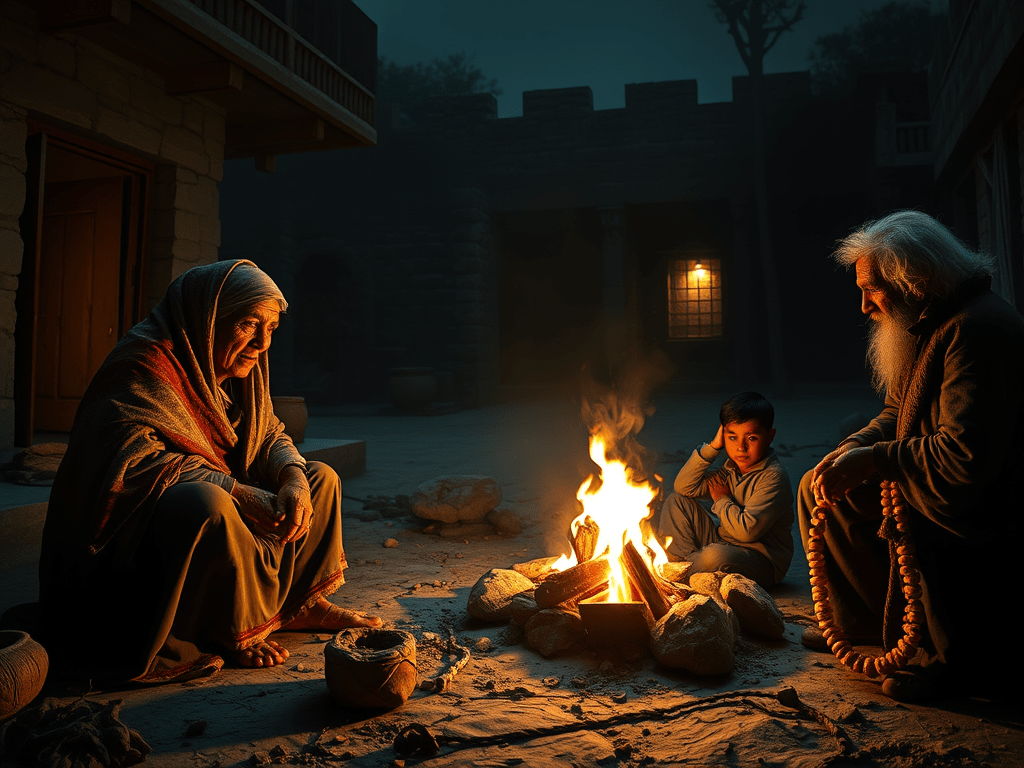
We’re sprawled around the fire, breaths visible in the biting cold. A thin fog, like a breath held too long, curled around our knees. There was the hunched woman, her ancient shawl scratching her shoulders, camphor clinging to her like a vow. The man across from her, palms raw, his thin kurta damp on the cold stone bench. The boy, hoodie useless against the bite, a marigold garland trembling on his creaky charpoy. And me, the elder, my sandalwood beads clicking, the Syonkar who thought a thali brimming with jaggery and rice could buy rain, not this devastating truth. Deeba saw through us tonight—my sin laid bare, his inherited debt exposed, her ancient, terrifying will made manifest. We’re talking now, to each other, to you, because this night, raw and unforgiving, needs a witness.
I shift on my jute mat, the rough fibers digging into my skin. Decades I’ve sat like this, watched countless Jagars. I am Mauli, the priestess, the one who tends the Kuldevi’s altar, who remembers the old ways. But tonight, more than ever, I felt her. Not just devotion, but fusion. You think I’m just the hunched woman of this village, but tonight, I am Deeba’s will made flesh, walking among my people, watching them forget. I lean toward the Dagariya, my voice low, like the moan of anklets in the sanctum, a sound that promises both blessing and doom. “You felt her, Mohan, didn’t you? When she came without the Rakt Mantra—no claw marks, no blood on the thali. Just her shout, like when she woke the hills against the Gorkhas in those forgotten wars. A sound that stripped the very air from our lungs.”
My shawl—woven with threads dyed from mountain roots, older than the Sam Veda itself—rustles. I swear it moves on its own, imbued with the sacred currents of the night. Jagar’s no stage play, no quaint tradition for tourists or distracted villagers. It’s blood and bone, a primal pact passed down from when shamans first sang in these hills, their voices cracking the sky to summon Bhumiya and Kshetrapala, the spirits of land and protectors of fields. We call it Dev Jagar now, refined by centuries of belief, but the lineage is unbroken. Like Hmong gongs calling ancestor spirits across misty valleys, or Lakota vision quests where truth is seen in starvation and isolation, we Jagaris summon the divine with rhythm and voice, body and soul. Tonight’s Dev Jagar was meant to honor Deeba, our Kuldevi, our protector, but your half-hearted chants, Mohan—those city dreams lingering in your throats—they were an insult. They didn’t call her, they forced her to wake, to remind you who she is, who we are. I rearranged the thali myself, before the ritual began, a small, subtle shift in the offerings: split the coconut with a thought, scattered the jaggery like dust, knotted the raksha sutra into a silent, potent warning. “They think Jagar’s just a show now,” I say, my gaze cutting across the dying embers to the boy. “But it’s blood and bone, kid. Always has been. The mountains themselves remember when we didn’t just sing, we became the gods.” The ancient, unyielding power of these peaks is her essence, and she stirs when neglected.
My throat’s raw, tasting of ash and something metallic, like I swallowed a storm. The chill bites through my thin kurta as I slump further on the stone bench. “Don’t act like it was nothing, old woman,” I snap, my voice hoarse from the hawan’s smoke, from Deeba’s fury pouring through me. “You saw what she did to me.” I hold up my hands, palms red as if I’d gripped burning ropes, the skin stretched and puckered from the divine current. The damru’s rattle still buzzes in my skull, its double-headed pulse the frantic heartbeat of every Dev Jagar since the hills were young.
I am Mohan, a Dagariya. I trained for years under Guru Ji, learning the subtle art of the vessel. He taught me the Sankalp—the precise Sanskrit vow, the offering of rice that opens the ritual and invites the deity. He taught me how to let the gods speak through me, to be a conduit, like the Navajo singers who channel ancestors or the Vodou priests who ride spirits, guiding the energy, never losing control. That was the training, the discipline, the pride of my lineage. But tonight, Deeba didn’t wait for the Sankalp. She ignored it. She tore through me, not inviting but invading. My spine bent until I heard it crack, a sickening snap that echoed in the silent temple. My voice—mine, but wrong, a guttural rasp that scraped against my soul—split into hers. It was not possession; it was a violent taking.
Through my mouth, her words boomed, echoing off the ancient stone walls, raw and unyielding. The dogs in the village howled in harmony with her pronouncements. “She named you, boy,” I say, my eyes flicking to the terrified kid, his knees pulled tight to his chest, shrinking from the dying fire. “Said your blood owes a debt. You know what she meant?” Then my gaze shifts to the elder woman, her prayer beads clicking like a nervous pulse, a frantic rhythm against the chilling air. “And you, Amma—she called out your sin, didn’t she? Something about your brother’s bones.” I shudder again, the memory of her words pouring from my mouth, the sheer, crushing force of her presence, still too vivid.
Jagar’s evolved, yes. Guru Ji used to explain it. Once, it was just hymns to wake the gods. Then it grew, absorbed, became a complex dance of trance and possession, blending ancient Vedic chants with the vivid folk tales of our beloved Kuldevtas like Golu Devta, the god of justice, or Nanda Devi, the mountain goddess. But tonight felt older, more primal than any Dev Jagar I’d ever performed. It felt raw, like the whispered tales of Bhoot Jagar my grandfather spoke of—the risky, terrifying rites where deceased spirits, not benevolent gods, take the stage, demanding truths only the dead truly know, often leaving madness in their wake. Tonight was worse. It was the goddess herself, unhinged.
My hoodie’s useless against the Himalayan bite. I’m curled on a charpoy, the woven ropes creaking under me, digging into my ribs. The fire’s warmth barely reaches, and I’m too spooked to move closer, too afraid to break the fragile circle. “I don’t know what she meant, okay?” I mutter, my voice cracking like the dholki’s frantic beat tonight, the memory of its rhythm still rattling inside my skull. “Mom dragged me here for ‘heritage.’ Said it would ‘connect me to my roots.’”
Mumbai’s all concrete and noise, all bright lights and Wi-Fi, not… this. This village smells of wet earth and something heavy, like secrets buried under the very ground, leaching into the air.
I tried filming the Jagar, before she came. Thought it’d be cool, something to show my friends back home. But my phone showed only static, a screen of hissing snow, like Deeba hid from the lens, mocking my modern tools. And then, through Mohan—when he, when she—said that debt thing, my chest tightened. It wasn’t just fear; it felt like a physical constriction, like I couldn’t breathe, like a cold hand was pressing on my sternum. Was it just the atmosphere, or was it… her, staring through me?
I glance at the temple, where Durga’s black idol looms, flanked by Jaya and Vijaya, her ancient guardians. Back home, gods are statues on altars, adorned with flowers, placid. Not… whatever this was. Nana, my grandfather, used to talk about Jagar. He said it was like the Native American sweat lodges, a way to talk to spirits, to purify. He mentioned our family owed Deeba for land we took generations ago, a debt of broken promises, a curse on our line if not appeased. I thought it was just old stories, something grandmothers tell children. Tonight, the Jagar Gatha—the sung tales of Deeba’s battles against demons and injustices, her furious justice—felt alive. The Jagari’s voice, though not Mohan’s, wove myths older than the migrations that brought Rajput and Punjabi blood to these hills, merging their gods with ours, binding us all to this ancient soil. The hawan fire burned too bright, its heat unnatural, and the prasad—sweet rot and arse—tasted like it carried not just her blessing, but her warning, clinging to my tongue. “Is this how Jagar always feels?” I ask, my eyes meeting the elder woman’s, pleading for an answer. “The drums, the shaking, the… the goddess taking over?” I clutch the marigold garland tighter, its petals cold as stone against my clammy skin. “I’m not sleeping. What if she’s still here? What if the debt is… mine alone to pay?”
My prayer beads—sandalwood, worn smooth by decades of worry and devotion—click in my lap, a nervous rhythm to keep me steady. The prasad’s sweetness lingers on my tongue, mixed with the bitter tang of guilt, an acid churn in my gut. I am Shanti. Tonight, I was the Syonkar, the host who commissions the Jagar. I had done everything by the book: ordered the offerings, ensured the thali was perfect, prepared the ghee for the hawan. I thought I was clean, my duties fulfilled. But Deeba is no ordinary goddess. “She’s here, boy,” I whisper, my voice low, cracked like the terraced fields in drought, the fields that haven’t yielded as they should for years. “In the frost, the stone, the idol. Everywhere.” I feel her, heavy as the frost on my doorstep, after she named my sin through that man’s lips: You buried the truth with your brother’s bones.
A land dispute, decades ago. My younger brother, weak-willed, easily swayed. The ancestral land, a prime plot. I wanted it all, for my sons. I manipulated, I lied, I forged documents. He died shortly after, a fever, but a shadow of doubt always clung to his passing. The field, barren now, a constant reminder of my betrayal. I thought the years, the silence, the rituals would hide it. I was the Syonkar, offering the thali—jaggery, raksha sutra, rice—to beg rain for the parched land, to beg forgiveness from the heavens. But Deeba came uncalled, her anklets moaning, and turned our hawan into judgment. The very ground seemed to tremble beneath us, the wind howled a lament.
“Jagar’s our lifeblood,” I tell the boy, my eyes meeting the priestess’s, sharp and knowing. “It’s not just a song or a simple ritual; it’s our court of justice, our connection to the living spirit of the Himalayas.” It’s been here since the Sam Veda’s hymns, when shamans sang to wake gods, much like the Andean healers who burn coca leaves to call Pachamama, seeking balance and truth. Our Dev Jagar calls Kuldevtas—Deeba, Narsingh, Nagraj—for protection, for blessings. But we have darker rites too. We don’t dare Masan Puja often, for those invocations of darker spirits see too much, reveal too much, demand too high a price. I point to the rain-making stone, a sacred slab by the sanctum, smooth from generations of hands turning it during drought prayers. “That stone—she turned it herself tonight, the moment the Dagariya fell into his trance. Not by human hand, but by her will.” My voice trembles. “Why us, Mauli? Why now? Why did she choose to shatter our carefully kept lies, after all these years of quiet?”
The priestess’s laugh is sharp, like a blade on cedar, cutting through the heavy air. “Why? Because you’ve forgotten Jagar’s heart,” Mauli says, her voice echoing off Diba Danda’s peaks, suddenly resonant with ancient power. She hums a Jagar Gatha, Deeba’s battle with Gorkhas, her voice weaving Vedic hymns with folk tales from Rajput migrations, a tapestry of history and faith. “You think Jagar’s stayed the same? It’s grown, absorbed, adapted—from simple invocations to complex trance-possession rituals, like Siberian shamans riding wolves through snow, carrying messages between worlds. But you sing half-hearted now, lost in city dreams and forgotten duties, and Deeba won’t stand for it. She demands truth, as she always has, from the very first dawn of these hills.”
The Dagariya stands, fists clenched, his body still faintly vibrating. “I trained for years—the Sankalp, the Gatha, the damru’s beat, how to control the flow, how to let the goddess in without breaking. My guru warned of Bhoot Jagar, when spirits, not gods, speak, when the Dagariya risks madness. Tonight was worse. She didn’t possess me; she consumed me.” His eyes dart to the bleeding trees, their bark oozing crimson in the faint light, said to be cursed villagers turned to wood. “She named your sin, Shanti, and I, the vessel, paid for it.” He takes a stumbling step toward the rain-making stone, a primal urge driving him. “Maybe I’ll turn it—prove she’s gone, reverse whatever she started.” He reaches out, but a sudden, violent gust of wind slams him back, unseen hands pushing him, and the hawan flares red, its dying embers momentarily rekindled into a furious blush. He stumbles, falling hard on the cold stone, his palms bleeding anew, tiny red rivulets against the faint grey light.
The Mumbai boy gasps, clutching the garland to his chest. “Don’t! Nana said the stone brings storms if you turn it wrong. I… I touched it earlier, before the Jagar. Just curious. Did I call her? Did I… trigger this?” His voice shakes, but something shifts in his eyes. He slowly stands, a new resolve hardening his young face, and deliberately ties the marigold garland around his wrist, a simple, spontaneous act of devotion. “I’ll learn the Gatha, Mauli. I owe her—my family does. I can’t run from this anymore.” His eyes meet the black idol’s, unblinking, no longer just curious but deeply, profoundly shaken.
I rise, my sandalwood beads slipping from my lap, scattered on the cold ground. “Enough hiding.” The words are a whisper, yet they carry the weight of decades. I walk to a gnarled tree at the edge of the courtyard, its bark rough under my fingers. From a knot, it oozes red, warm, like my guilt, a silent witness to my past. “My brother’s land—I took it. Every lie, every manipulation. Deeba knows.” I turn to the sanctum, the black idol watching, unblinking, from the temple’s depths. My hands move instinctively, leaving my worn beads at Durga’s feet, a final offering, a silent plea for forgiveness. The frost cracks around us, a chorus of tiny whispers.
Mauli sings again, louder, the Jagar Gatha rising, ancient and compelling. Mohan joins, his voice cracked but steady, imbued with the raw power that still hums beneath his skin. Then Arjun, halting at first, but earnest, his young voice finding its place in the millennia-old chorus. I hum too, my voice low, cracked, adding to the collective prayer, our voices echoing off Diba Danda’s peaks, calling to something beyond human comprehension. The fire dies, plunging the courtyard into deeper shadow, but the temple bell tolls on, backward, a low, resonant note carried on the wind, echoing into the faint light of dawn. Mauli’s eyes glow—inhuman, fleeting—then dim, becoming merely the eyes of an old, wise woman. She looks at you, through the dark, through the page. “You’re carrying this story now. What will you do with Deeba’s truth?”
 Moon at Half Past Noon
Leave a comment