My name is a shape the rain dissolves.
But my territory is the hot blacktop,
and my skin is a map of the city’s dry veins
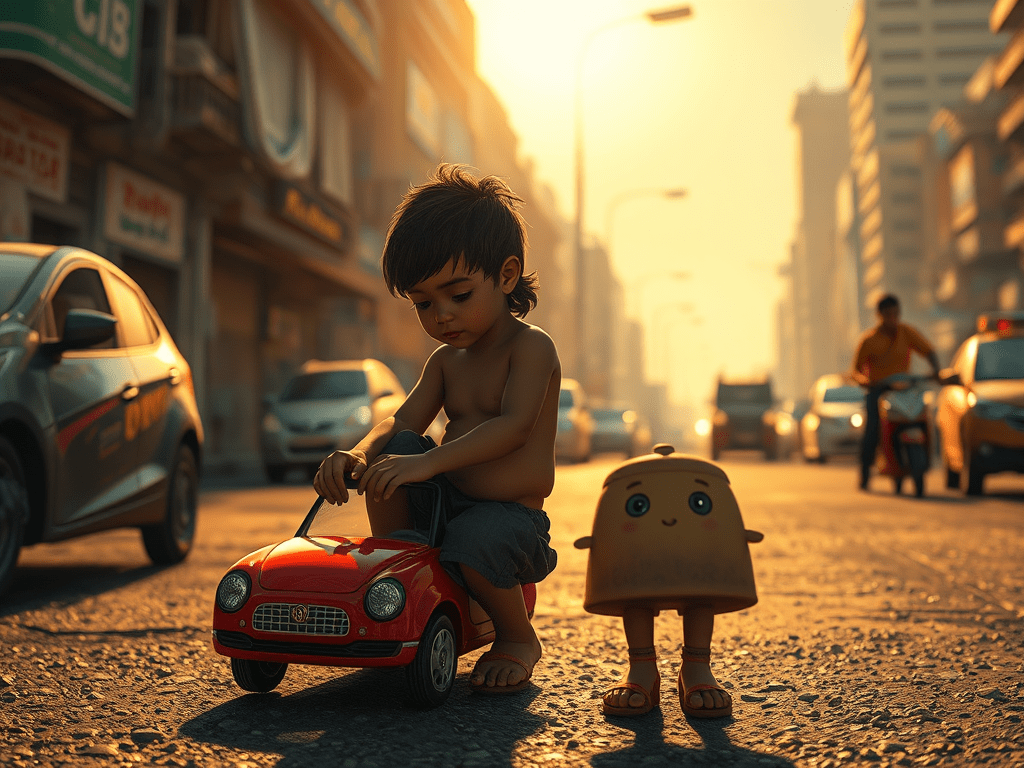
My partner, Chotu, is a knot of twigs wrapped in yesterday’s shirt.
He practices his look—one eye squinted shut against the sun-glare.
I polish a plastic red car with the hem of my shorts,
rubbing until it gleams like a false promise.
“For your son, Uncle?” My voice is the scrape of a match.
A woman with eyes like a quiet balcony looks down.
I don’t ask for coins. I point to Chotu’s throat, a pantomime of drought.
She buys two samosas. The grease is a prayer we swallow whole.
The sun is a weight on the back of my neck.
A man in a white car is an island of cool air.
I don’t tap. I press my whole, warm hand against his glass,
a sudden smudge of life. He flinches.
I hold his gaze, a silent game of who will blink.
My other hand points to the perfect, black tire.
“It’s hungry,” I state. “It’s eating the road.”
He looks from my eyes to the tire, confused into belief.
His window stays shut, but his fingers push a coin
through the thin slit at its base, a surrender to my fiction.
We feel him before we see him—a sudden stillness in the chaos.
The traffic hawk has landed.
His uniform is a stiff, blue complaint in the heat.
He doesn’t run. His presence is a wall.
He once stood so close I could smell the stale samosa on his breath.
His stick, almost gentle, hooked the handle of my basket.
He lifted it, his eyes on the traffic light, not on me.
“Green means go,” he muttered, and walked away,
taking half my day’s hope with him, a toll for this piece of road.
Some cars don’t roar; they slither.
This one stops with a soft, expensive sigh.
The window sinks down without a sound.
Inside, the air is cold and smells of perfume.
The man has gold on his wrist and a smile that doesn’t reach his eyes.
“Do you like chocolates?” he asks, his voice slick as engine oil.
He holds a glossy bar, a trap wrapped in foil.
His other hand rests in his lap, moving in a slow, private rhythm.
I don’t answer. I turn and melt into the jungle of idling buses,
the taste of his question like something rotten in my mouth.
A whistle. Two short, one long. It is Babua.
His body is a question the city never answered.
His eyes are puddles of kerosene, waiting for a spark.
He doesn’t need a ledger. His memory is a knot of every debt.
Chotu’s coins are few. Babua’s silence is a verdict.
No words. A glance toward the truck’s fender, baking in the heat.
Chotu walks over and presses his forehead to the metal.
A small hiss, like a secret being burned away.
This is how Babua leads. He was tempered in this same fire,
his own childhood melted down to forge this cold tool.
The city begins to bleed light, a wound we watch from afar.
Babua herds us, a current pulling debris.
Our shelter is a rip in the world’s fabric, stitched from sackcloth and fear.
A woman stirs a pot, the steam the same grey as her hair.
Babua stands before The Man on the Cot, whose leg is a ruined pillow.
He speaks no numbers, only a low, guttural sound.
The Man’s hand twitches, a flicker of violence in the gloom.
Babua’s shoulders tighten, a rope pulled taut.
Inside, I use my spit to cool the brand on Chotu’s skin.
He is a silent statue. We break a piece of bread, a shared bone.
Babua sits alone, scratching at the dirt with a nail.
He looks up, and our eyes meet in the settling dark.
I do not see a monster in his gaze.
I see my own reflection, hardening in the mold.
 Moon at Half Past Noon
Leave a comment