“Listen,” he says, the word a crackle in the night,
a command that stills the clink of glasses.
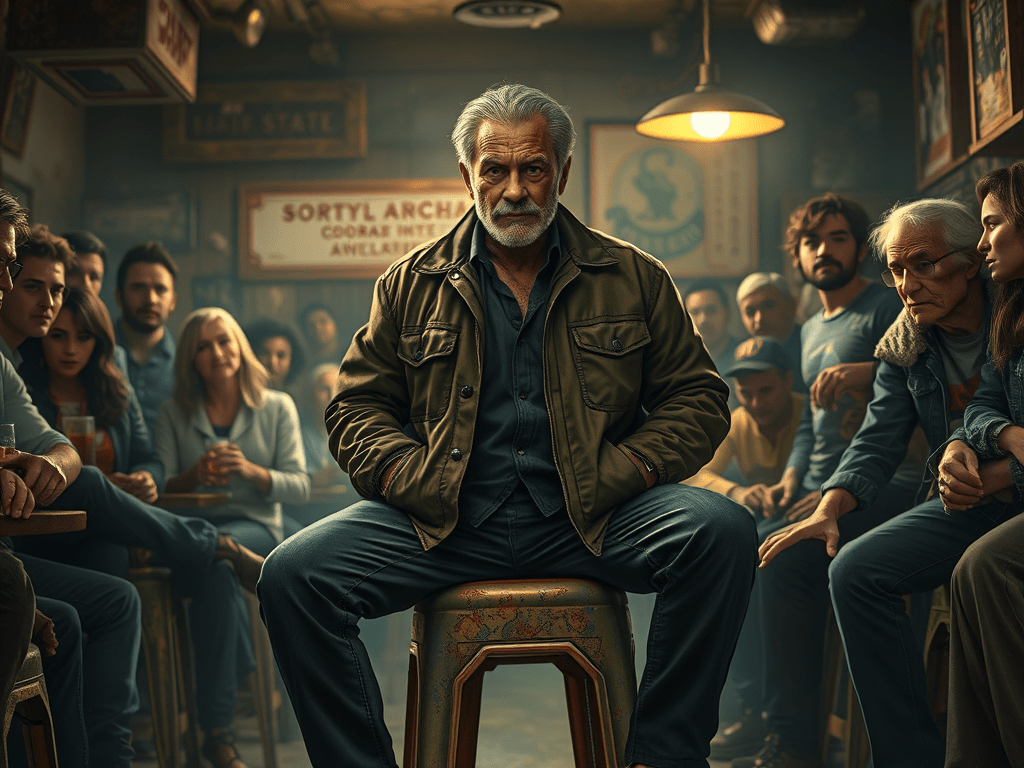
He leans in, the only man I know who can make a plastic stool
feel like a throne. The circle of faces—grey, young, enchanted—
tilts toward his light, like planets to a dying, brilliant sun.
He pats his jacket, a gesture worn smooth as a river stone.
“These pockets,” he grins, a flash of the old conspiracy,
“are not just torn, you see. They are my archives.”
The left one, he claims, let the Old Monk bleed
into the dust of a hundred forgotten addas,
each dark stain a testament against the sober tyranny of now.
The right one, where he kept his childhood—
a spinning top, a river-smoothed stone,
the brittle, folded blueprint for a dawn—
wore through from the constant weight of what never was.
“I am a man of my time,” he declares, toasting the air,
“which is to say, I’m stranded in a time
that no one booked a ticket for.”
His tales are tall, we know, and lean a little now.
But we are listening. He begins…
I was there when
the Babri dust was still a wisp of smoke in the air,
and we argued dialectics till the samosa stall shut down.
I wrote the future on a napkin, with a Naxalbari edge;
we’d split a single cigarette, a single hope, four ways.
I once convinced a traffic cop of socialist traffic flow—
for ten minutes, the intersection was a commune!
I courted a woman with quoted Faiz and a stolen rose,
and for a whole monsoon, it worked. Believe me.
My India is the checked cotton I lived in, not the stiff wool they sell.
It’s the rumble of an Ambassador, not the whisper of a Tesla.
It’s the crackle of a paper manifesto, not the glow of a meta-verse.
I never owned a screen; the news came to me on the street,
loud and flawed, straight from the lungs. The dramas I watched
were real, staged on campus greens,
with heroes who had bad knees and magnificent vocabularies.
I have friends in all the big places now, with big pockets.
They wear their surrender like well-tailored suits.
They deserted the cause for a corner office view.
Just last week, across a small table:
“Traitor,” I announced, the cheap Rum Dudda still burning on my breath.
I leveled the accusation at old Sunil, who now runs a consultancy firm
and is losing his hair the predictable, corporate way.
“A class traitor, pure and simple. You swapped the street for the spreadsheet.”
Sunil just smiled, that kind, tired smile of the truly wealthy.
He slid the bottle closer to me. “Still the same old sermon, Dudda,”
he murmured, his tone more weary than scornful.
“Except the congregation is smaller and the rum is cheaper.
I paid for the bottle, by the way.”
“A bribe! A tax on your guilt!” I laughed, taking a long drink.
He knows I will never betray this rum for the sake of a revolution.
It is my last, honest sacrament.
And yet,
when his daughter, wide-eyed, brought me a wobbling tower of blocks,
my voice, which just railed against the neo-liberal machine,
dropped to a murmur fit for lullabies.
My hand, which once only knew how to make a fist,
found the weight of her small head, and rested there—
a gentle, steadying anchor.
In that silence, even my scars looked like wisdom.
They saw it then, the old fire, not as a threat, but as a hearth.
And for a moment, in the quiet comfort of my palm,
the future didn’t seem so fragile.
We are all just keeping something from breaking.
Yes, the hair has migrated south, a strategic withdrawal.
The old barricades are ghosts I trip over in the dark.
The new revolution is a hashtag, and my fingers forget how to click.
The new capitalism is an algorithm that finds my life irrelevant,
and offers me a loan for a scooter I don’t need.
But look at my eyes.
Go on, look.
They are not screens, bleached by a billion pixels.
They are the last analog projectors, still running a shaky, glorious film
of a world they promised us, a world we nearly seized.
They are bright not with victory, but with the un-spent energy
of a fight I never finished, only rerouted.
So these pockets are empty. Good.
It makes for lighter walking.
The left one now lets in the air, the right one, a chance to carry something new.
Perhaps a seed, perhaps a note for a new, quieter rebellion.
The map is worn away, the territory is still mine.
The flag is a handkerchief, but I still fly it, wiping the sweat from my brow.
It was never about winning. It was about the story.
And my friend, the story is not over. It’s just being told
by a man with bright, bright eyes, and pockets full of sky.


 Moon at Half Past Noon
Leave a comment