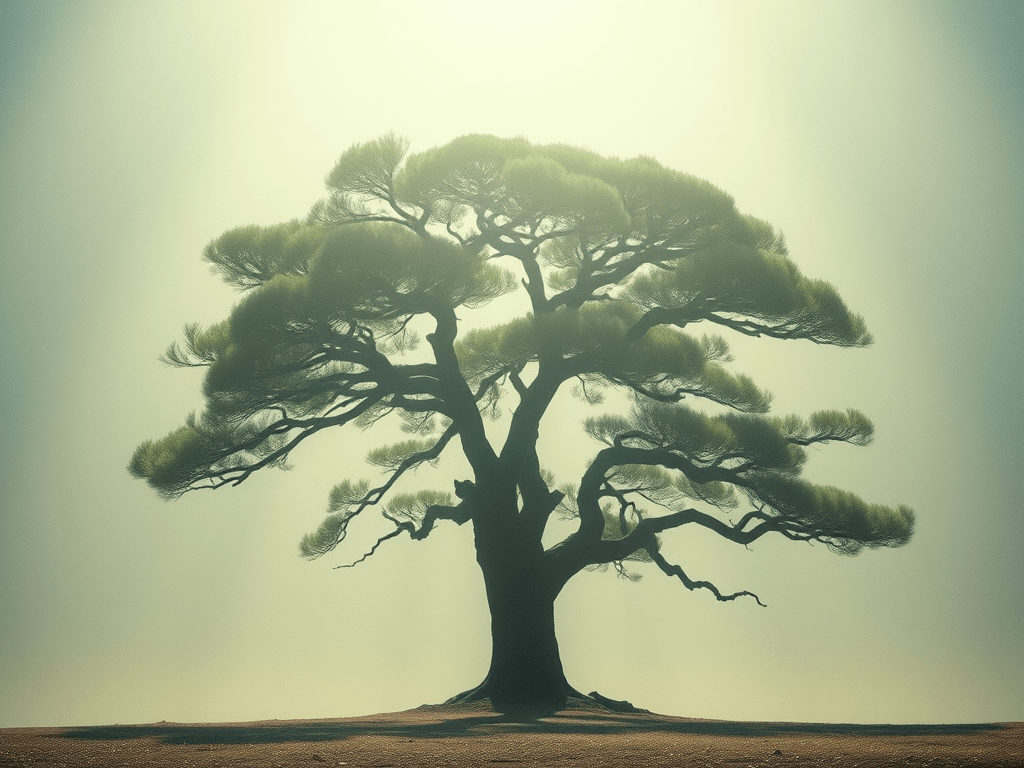
The concept of honorable poverty (shibumi) finds profound expression in Japanese Noh theater. This aesthetic ideal celebrates spiritual richness through material minimalism. On the Noh stage, this is embodied in the stark, almost empty space (ma), where a single pine tree symbolizes the entire universe. The slow, deliberate movements of the actors and the haunting music of the flute (nōkan) and drums evoke a deep, mysterious beauty (yūgen). Through tales of ghosts and legends, Noh reveals that true poverty is not a lack of possessions, but freedom from desire, achieving enlightenment through austere beauty.
A Noh Ballad in Five Acts
CHARACTERS:
- SHITE: The ghost of a Samurai, Lord Kiyotaka, bound by his attachment to a failed vow of frugality.
- WAKI: A wandering Zen Monk, embodying shukke (the monastic life).
- TSURE: The Monk’s companion, a Poet-Aesthetic, a spirit like Bashō.
- JIUTAI: The Chorus, representing the voices of nature and timeless wisdom.
- KŌKEN: The Stage Attendant, a silent witness.
(JO — THE INTRODUCTION)
(The Waki and Tsure enter. The Waki carries a single begging bowl. The Tsure has a worn satchel and a look of serene observation.)
WAKI (The Zen Monk):
The path is long, the alms but rice and tea.
This takuhatsu, this humble, daily round,
Wears down the self, and sets the spirit free
From wants that on the mortal plane are bound.
We own the moon, the wind, the falling snow.
TSURE (The Poet-Aesthetic):
And we the words that from the spirit flow.
A verse composed on seeing morning dew
Is wealth enough for me, and for you, too.
See, Brother, how this ancient pine tree leans,
Its form a perfect lesson in restraint.
A beauty born of weathering, it means
More than a grove that knows no touch of taint.
JIUTAI (The Chorus):
Two travelers walk where earth and ocean meet.
One seeks for grace, the other finds it made
In crooked branch and wave’s unending beat.
They walk in light, and are not afraid.
(HA — THE EXPOSITION)
(The Shite appears, disguised as a ronin—a masterless samurai—his kimono frayed but his posture rigid with pride.)
SHITE (as Ronin):
You stop beneath this tree? It is well-chosen.
It weeps for failures heavier than stone.
I was a lord, by strictest vows sworn, frozen
To duty’s path, which I walked all alone.
My hall was bare, my rice was coarse and plain,
My retainers grumbled at my rule.
“No luxury that might the soul detain,”
I preached, a harsh and unforgiving fool.
This blade, my soul, I honed for one great war.
But news came slow, the battle lost and done.
My frugal pride now stands for nothing more
Than chances lost, a perished, setting sun.
WAKI:
Your poverty was honorable, then.
A Samurai’s code, to transcend the world of men.
SHITE (as Ronin):
Honorable? A cage of my own design!
I clung to form and missed the sacred heart.
I saw my duty in a rigid line,
And tore my clan and my own soul apart.
I stored the grain, but let the spirit starve.
For this, the weeping pine trees mourn and grieve.
TSURE:
A poem half-composed, that could not serve
The truth of the moment it sought to achieve.
You polished the sword, but let the hand grow weak.
JIUTAI:
He speaks of a mountain he never could climb,
A strict, cold beauty, hollow and sublime.
He now wanders, his spirit frail and bleak,
Seeking a path to cross the sea of time.
(KYŪ — THE CLIMAX & DANCE)
(The Shite exits. The stage is filled with a sense of anticipation. The Kōken, the stage attendant, adjusts the space, a silent guardian of the transition. The Shite re-enters as a powerful, anguished ghost, clad in the brilliant armor of a Daimyo, but with a cracked, sorrowful Noh mask.)
SHITE (True Form):
I am the Lord who built a tomb of “No!”
Who thought that less was always, always more!
Who bound his soul with rules, and let love go,
And barred the spirit from the great hall’s door!
Now, see the dance of what was left undone!
(The Jiutai chants as the Shite performs a slow, powerful, and agonized dance [mai]. The Hayashi drums beat a complex, troubled rhythm.)
JIUTAI:
The arm rises, a promise made of steel!
The foot stamps down, a law both hard and fast!
He turns and turns, in his self-spun ordeal,
Trapped by the shadow that his past self cast!
He seeks the clutter of his own harsh mind,
The stacks of pride, the dust of old disdain!
A fortress of the self, he cannot find
The key, and so his sorrow must remain!
WAKI:
The fault was not in lack, but in the grip!
You held the virtue, but you lost the soul!
TSURE:
A poet knows the verse must sometimes slip
From strictest form, to be made truly whole.
(The Shite freezes in a powerful Mie pose, his body a glyph of torment.)
(RESOLUTION — THE DANSHARI OF THE SPIRIT)
KŌKEN:
(The Kōken, for the first time, moves. He brings forth a simple, unadorned wooden box and places it center stage. This silent act is profound.)
WAKI:
The modern sage speaks of “Danshari’s” way:
To refuse, dispose, and separate.
Cast off the pride that holds you here, we pray.
Not stuff of life, but self-created weight.
TSURE:
Refuse the identity of “Lord of Lack.”
Dispose of this old story of your fall.
Separate the man from the warrior’s track.
Be nothing, and in nothing, have it all.
JIUTAI:
A letting go. A breath. A silent grace.
The armor fades, a mist upon the sea.
The stern lines soften on the spirit’s face.
What is he now? At last, he’s truly free.
Not Samurai, not Lord, not ghost, nor name,
But like the monk who owns the sky and rain,
Or like the poet, for whose soul a flame
Is lit by what most others see as plain.
The honorable poverty was never in the shelf,
But in the uncluttered, peaceful, timeless self.
(The Shite slowly rises from his Mie. His posture is no longer rigid, but fluid and accepting. He looks at his hands, then at the Monk, the Poet, and the silent Kōken. He bows deeply. His form dissolves into the light coming from the sea. The pine tree seems to stand a little straighter. The Monk and Poet turn and continue their journey.)
WAKI & TSURE (in unison, as they exit):
The path is long. The path is clear.
 Moon at Half Past Noon
Leave a comment