
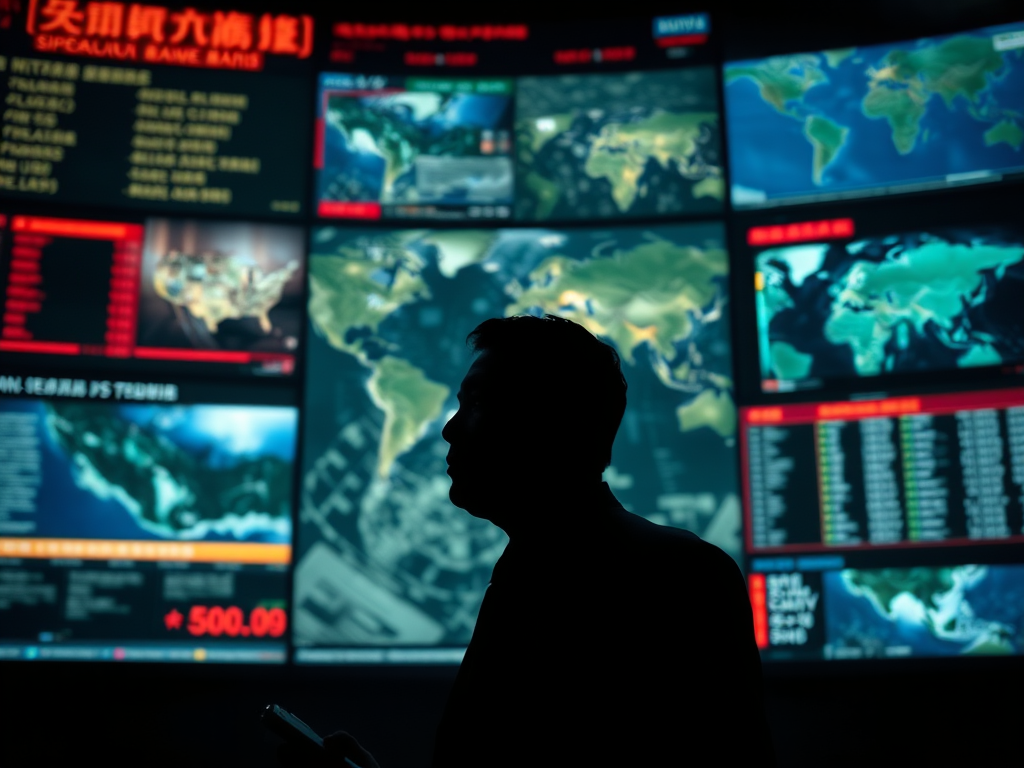
(The lights come up on a single figure, silhouetted against a screen flickering with news tickers and satellite maps. The tone isn’t of a raving conspirator, but of a cold, diagnostic observer. The voice is measured, precise, and carries the weary authority of a pathologist.)
Good evening. Let’s dispense, for a moment, with the theater. The panic, the flags, the solemn speeches about freedom and borders. They are set dressing. We are here to discuss the operating system.
You are concerned about war. I understand. The headlines scream of trenches and missiles. But you are looking for a fire in a house where the owners have already sold the land to developers. The real event is not combustion; it is the quiet transfer of title. War, in its classical sense, is inefficient. It is a failure of imagination. The contemporary architect prefers… liquidation. Not of assets, but of sovereignty. Of political risk. Of the very idea of a people as an unruly, autonomous entity.
What has emerged is not a cartoonish secret pact, but a convergent set of interests—a de facto syndicate of liquidation. Call it not a “G3,” but the Triumvirate of the Transactional. Their currency is not just money, but data, energy, silicon, and human capital. Their method is not conquest, but conversion—converting nations into platforms, citizens into users, and resources into securitized streams.
We see this conversion most starkly in the Arctic. In Greenland, they speak of “Green Colonialism.” Note the grammatical miracle: the adjective absolves the noun. The project is not to possess the land, but to unlock it. To convert millennia of ice, and the communities upon it, into a logistical problem solvable by capital. The narrative is “saving the planet.” The substrate is lithium, cobalt, rare earths. The local population is not an adversary to be defeated, but a stakeholder group to be managed—a line in an ESG report. Resistance is not met with troops, but with tailored economic inducements and, if necessary, the gentle, inexorable pressure of credit ratings and supply-chain exclusivity. The glacier melts, and a new mine, with a wind farm beside it to power the extraction, is hailed as a monument to sustainability. The contradiction is not an error; it is the engine.
But while the Arctic is unlocked for its raw matter, the Pacific is being drained of its intellect. Look at Taiwan. The “Silicon Shield” is not a fantasy, but a miscalculation. It assumes indispensability guarantees protection. But what the protector seeks is not the shield, but the algorithm. Not the goose, but the golden egg-laying process. The goal is redundancy, not reliance. You witness the gentle, legalistic evacuation of technological sovereignty—the “partnerships,” the “knowledge transfer,” the “co-location” of fabrication. Arizona, not the Taiwan Strait, is the new front line. Once the process is replicated, the island’s strategic value is demoted. It ceases to be a vital organ and becomes expendable tissue. The defense pact becomes a document subject to renegotiation. The tragedy is not betrayal, but the serene, actuarial logic of supply-chain management.
This managerial logic extends beyond technology into the very definition of statehood itself. In places like Venezuela, we have moved beyond the crude dichotomy of “democracy” versus “dictatorship.” The new model is the Subscription State. Sovereignty is a tiered service. Basic access to the global financial grid—the ability to process transactions, to buy medicine, to sell oil—requires accepting certain terms of service. You subscribe to a monetary platform (the dollar, the euro, a digital currency), to a security protocol (implicit alignment), to a data-storage agreement. Your political leadership is a user interface; some interfaces are more preferred by the platform administrators than others. “Sanctions” are not punishments; they are the revocation of access credentials. The people are not liberated or oppressed; they are users in a territory with poor service.
And where the user interface fails completely, we see the most profound innovation of all: the financialization of destruction. Look at Ukraine. War is not a political failure here; it is the catastrophic but necessary precondition for a spectacular investment opportunity. One portfolio—geopolitical, military—funds the demolition. Another portfolio—financial, industrial—holds the exclusive rights to the reconstruction. The nation is not defeated; it is leveraged. Its greatest asset becomes its own catastrophic need to rebuild. Its future GDP is mortgaged to pay for the rubble. The loans are structured, the contracts pre-negotiated. The tragedy is converted into a complex financial instrument: a Freedom-Backed Security. Valor and debt become indivisible.
Even the old centers of power are not immune to this restructuring. Europe is not dismantled; it is curated. A unified, assertive Europe is a rival. A fragmented Europe is a marketplace and a tourism preserve. The tools are not tanks, but algorithms—the ones that fund and amplify the politics of resentful nostalgia. The Far Right, the separatists, the neo-nationalists are not ideological projects; they are market-disruptors. They are venture-capitalized to break the continental union into more manageable, competitive subsidiaries. It is a leveraged buyout of the European idea, paid for with its own social capital.
You ask about law. International law is not broken. It is obsolete. It was built for a world of discrete, opaque nation-states. We live in a world of translucent, overlapping platforms. The new law is protocol. The new sovereignty is API access. The new warfare is competitive integration—the fight to be the one who sets the terms by which others are plugged in, or locked out.
This is not a conspiracy. It is the emergent logic of late-capitalist geopolitics. There is no smoky room. There are golf courses, video conferences, Davos panels, and shareholder meetings where language itself is tuned to this frequency. The players are not mustache-twirling villains. They are visionary CEOs, state-fund managers, and innovation consultants. They believe in stability, growth, and elegant solutions.
The bottom line is this: They are not going to destroy the world. They are digitizing it. Converting its messy, bloody, poetic chaos into a clean, interoperable, and profoundly governable system. Your anger, your fear, your identity—these are not your rebellion. They are data points. The last human war will not be fought over ideology, but over the right to remain analog. To be a glitch in the system. A soul, and not a user.
The question is no longer which side you are on. The question is: Are you a citizen, or are you a protocol?
(A beat. The screen behind him shifts from maps to a vast, shimmering, endlessly complex network diagram. He turns to look at it. The lights fade to black.)
 Moon at Half Past Noon
Leave a comment