The street was a shared lung.
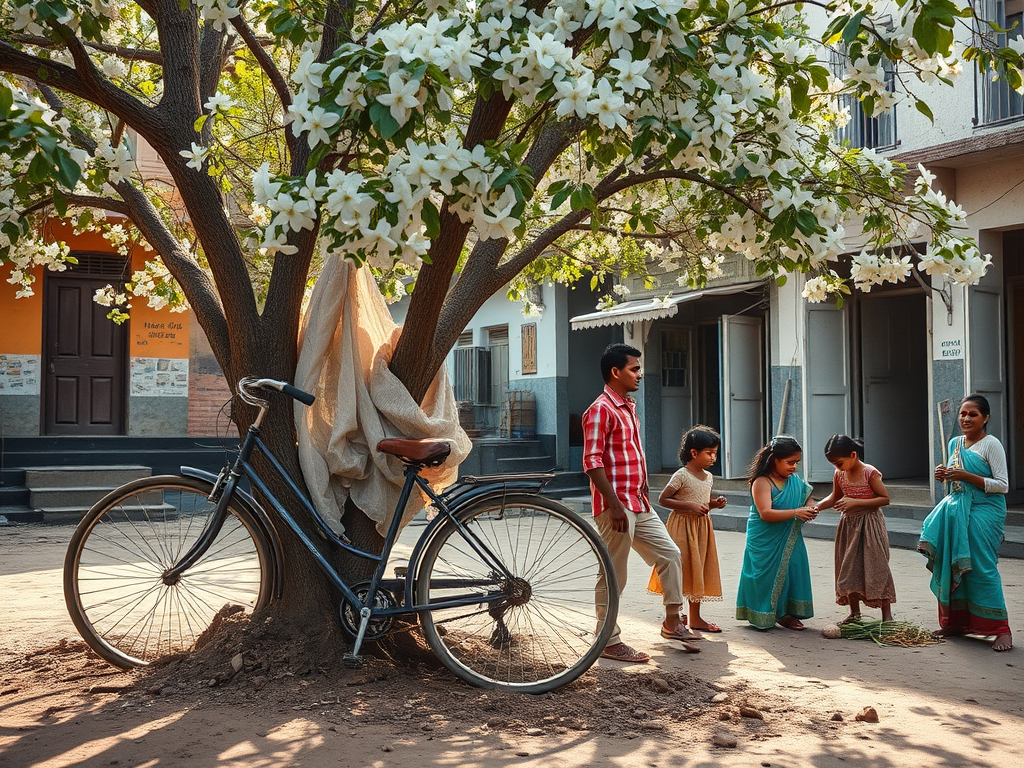
Grandfather’s cycle didn’t just lean against the gulmohar;
it anchored the house. Its rusted bell was the only clock we kept—
a jagged chime that told us when the tea was dark enough to pour.
We were a hierarchy of passengers on a purple Luna,
a two-stroke miracle of grease and prayer,
balancing four lives on a frame built for one.
Then the Vespa—a chrome-draped hull that didn’t just move us;
it gathered us. Five bodies on a single seat,
a knot of limbs held together by the gravity of the turn.
No one turned a key.
A door handle was a greeting, not a choice.
Mrs. D’Mello’s slipper was the only law we feared—
a flying leather verdict that punished the theft of a mango,
only to find yourself an hour later in her kitchen,
an embassy of refuge where the steam of dal dissolved the crime.
We drank from the same steel glass,
the cool, dented rim a kiss we all shared
without ever asking for the names of the ghosts before us.
When the rains came, we surrendered our skin.
We were mud-children, slick as oil,
rolling down the tap-lane incline until we were indistinguishable from the earth.
The street was our river, the gutter our Ganges.
No one called us in. No one was lost.
We were of the street, and the street always knew where to return us—
scraped, dripping, and finally, quiet.
Meals had no borders.
A roti migrated from my mother’s tawa to the widower next door;
a bowl of sambar arrived from the auntie across
because she heard our tempers were running thin.
The steel containers were the real currency—
the rhythmic clatter of their lids a second language
we spoke while squatting on thresholds,
our plates a messy geography of the neighbourhood.
The women gathered on the pavement,
their gossip a garland of voices.
They sat on low stools, cutting vegetables,
their knives keeping time with their tongues.
They knew everything—who had fever, who had fled,
whose son failed, whose daughter bled.
Their laughter bounced off walls,
their secrets safe in the noise of the day.
The men came home on rusty bicycles,
shirts sticking, eyes tired.
They climbed to the terrace, pretending to check the water tank.
Behind the drum, a bottle surfaced,
passed hand to hand like contraband.
“She doesn’t understand,” one would say,
and the others nodded, sipping,
the whiskey burning away the boss’s voice,
the factory shift, the borrowed money.
Below, the women knew.
Below, the women said nothing.
We lived in two rooms that breathed with us.
A puzzle of five on a single cot,
listening to the walls—thin as hope, transparent as a secret.
The house was a choir of interruptions:
the baby’s cry two doors down,
the old man coughing the dawn into his handkerchief,
the couple three doors up fighting over a forgotten debt.
You didn’t hear your neighbours; you survived them.
The mechanic worked in the open,
his tools spread on newspaper.
We watched him resurrect dead engines,
his hands black with grease, holy.
He would look up, wipe his forehead,
say to any passing child,
“Fetch me some chai, will you?”
And we ran, because his smile was currency,
because the scooter he fixed would one day carry us.
My mother, AAII (आई) , moved through this world
like its slow heartbeat. Her voice
was a scratchy radio playing old film songs,
her hands the smell of cumin cracking in hot oil.
She knew which neighbour’s child hadn’t eaten,
which old man hadn’t been seen since morning.
She sent me with a plate before I could ask.
Now, the walls have grown ears, but lost their mouths.
I nest in my cell, and twelve feet away, my daughter nests in hers.
We trade pixels like prisoners tapping on pipes—
her voice a flattened ghost of ones and zeros,
asking me for the time of day, as if the sun didn’t live outside.
The terraces are locked. The water tanks are silent.
The whiskey is no longer a contraband bottle shared behind a drum,
but a solitary pour in the blue light of a screen.
The mechanics have retreated to air-conditioned bays,
their hands gloved, their names erased by the invoice.
The women gather on encrypted threads,
their gossip a disappearing digital ink,
fearful of the very noise they once used as a shield.
Some nights, I stand in the hallway
and wait for the stone that used to prop the door open.
But there is only the hum of the server in the corner—
the house’s new, artificial snore.
Mrs. D’Mello has been dead twenty years,
her mango tree paved over for a parking lot that nobody uses.
But sometimes, in the absolute silence of the 3 AM corridor,
I feel a whizzy wind—
her ghost-slipper, still in flight,
still aiming for a child who finally learned how to lock the door.
My mother calls. Not AAII, just Maa on a high-definition screen.
She asks if I’ve eaten.
I lie, and the server carries the lie in a millisecond.
She knows. Some things aren’t data—they’re just the smell of cumin
cracking in hot oil, a smell the fibre-optic cables haven’t learned to carry.
I sit in the quiet, door closed,
remembering that the threshold was only ever a line of dust.
So easy to cross.
So impossible to find again.
And somewhere, in the server’s endless night,
the music of a rusted bell waits
for tea that will never be dark enough to pour.
 Moon at Half Past Noon
Leave a comment