The bus dropped him at a fork in the road where the tar ended and the pine forest began. A rusted signpost, pockmarked with what looked like bullet holes, pointed up a narrow trail: SAUR — 4KM.
Arjun climbed for an hour. The silence of the mountains was not the silence he had imagined. It was a pressure. It filled his ears until he could hear his own pulse moving behind his jaw.
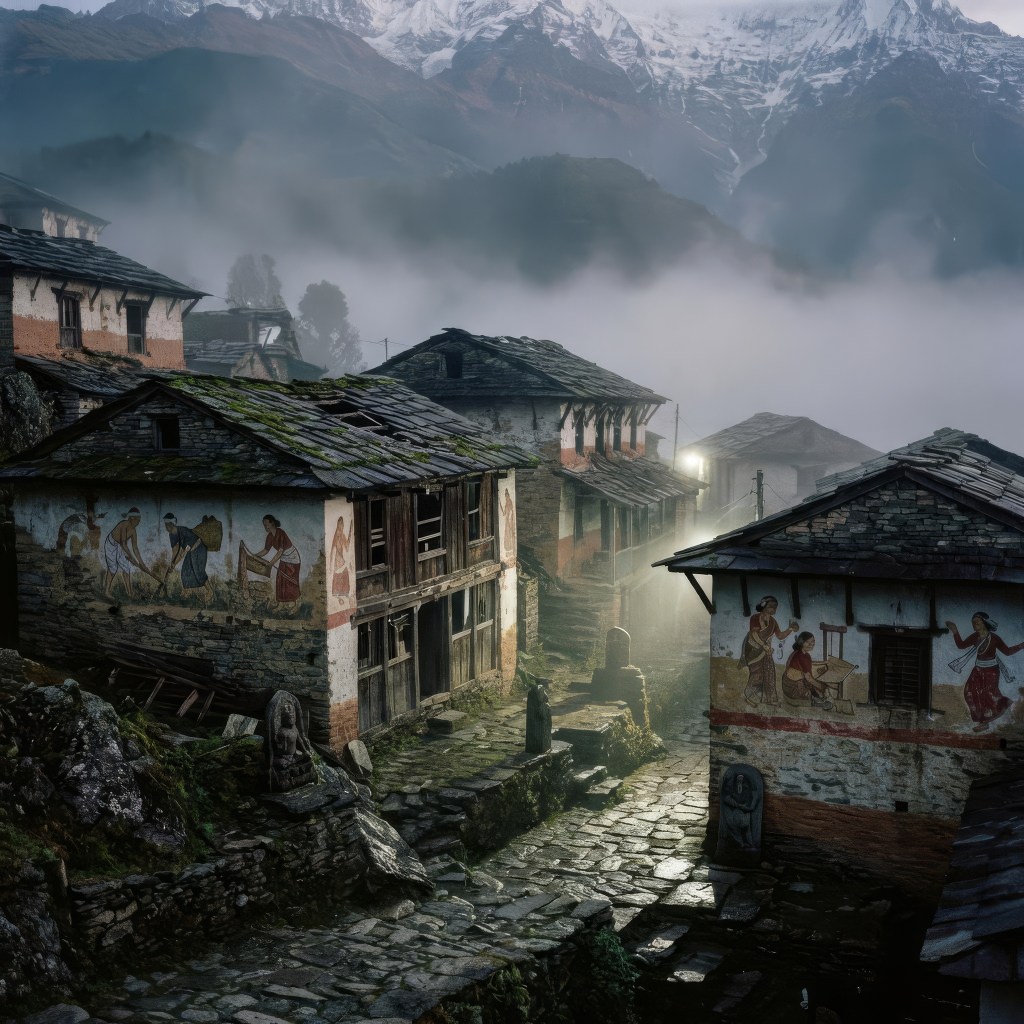
When he crested the ridge, the village lay below him, improbably intact. Slate roofs glinted. A thread of smoke rose from a chimney. He smiled, relieved. Not abandoned after all.
He walked in expecting tea. He walked in expecting a voice, a face, a hand raised in greeting.
The first person he saw was an old man on a veranda, smoking a hookah. Arjun raised his hand. “Namaste.”
The old man did not blink.
The second was a woman in a courtyard, a basket of grain balanced on her hip. Arjun called out, asking for water. The woman did not turn.
He stepped closer. The wind blew, but her saree did not flutter. He reached out to tap her shoulder.
His knuckles struck stone.
She was paint. The old man was paint. The child peering from a high window, the clothes hanging on the line, the goats clustered at the well—all paint. Hyper-realistic, life-sized, but flat against crumbling walls.
Arjun spun in the village square. Three hundred and sixty degrees of painted faces staring at him from every angle. The silence was no longer peaceful. It was predatory.
He found a house with a broken latch and barricaded himself inside. He lit his camping stove. The hiss of gas was too loud. He played music from his phone to push back the silence. Heavy bass rattled the stone walls.
In the dark, a shadow moved. Boots wrapped in cloth. A hand reached into a pouch and scattered white powder on the ground in a perfect circle around the house.
Arjun woke to light cutting through the broken window. He stepped outside to piss and stopped.
A thick line of white lime powder encircled the house. It was perfect. Geometric. Absolute.
Ten feet away, an old man stood holding a rusted rifle like a walking stick. He was tall, gaunt, his face carved into angles. His hands were stained with paint.
“That is your side,” the old man said. His voice was soft. It did not echo. “This is mine. Do not cross the line. You carry the sickness of the cities.”
Arjun laughed, nervous. “I just need water, uncle. I’m leaving tomorrow.”
“Tomorrow is too late. You are already changing the air.”
He did not leave. He could not. The trail he had climbed was swallowed by mist by midday, and the old man had taken the water.
Arjun tried to ignore him. But when he looked away, his drying clothes disappeared. When he tried the communal tap, it was painted red with a symbol he did not recognize. He confronted the old man in the square.
“Why are you doing this? There’s nobody here. It’s just us.”
The old man gestured to the walls. Hundreds of painted faces stared down.
“It is not just us. They are watching. And they do not like how loud you are.”
On the third night, a storm tore through the valley. Arjun’s shelter collapsed. Shivering, soaked, he crossed the lime line and knocked on the old man’s door.
It opened. The old man stood in the doorway, calm. Behind him, the room was a workshop. Jars of pigment. Brushes soaking in oil. A half-finished mural on the far wall.
The old man poured tea. Arjun drank it, grateful, not noticing the way the old man’s stained hands trembled with something that was not fear.
The screen blurred. The room tilted.
He woke bound to a wooden chair in the village square. Dawn light fell in long golden shafts. The old man stood before him, holding a palette and a brush.
“What are you doing?”
“Fixing you.” The old man dipped the brush in grey paint. “You are too messy. Too distinct.”
The first stroke landed on Arjun’s cheek. Cold. Wet. Spreading.
“Stop moving,” the old man whispered. He painted Arjun’s forehead, his jaw, his closed eyelids. “Be a good citizen.”
The horror was not the pain. There was no pain. The horror was the erasure. Arjun felt himself disappearing under the paint, becoming something that could stand still forever against a wall.
He screamed. The sheer existential force of it rocked the chair. He tipped forward, crashing to the stone floor. The palette flew from the old man’s hand. Red paint splashed across the pristine square.
The old man gasped. He dropped to his knees. He was not looking at Arjun. He was looking at the red stain spreading across the stones. He cared more about the spill than the boy.
Arjun wrenched his hands free. He ran. He did not look back. He plunged into the jungle, half-dried grey paint cracking on his skin, and disappeared into the mist.
Three weeks later, the village was pristine again. The red stain was gone. The lime line had been swept away.
The Warden stood before the house where the intruder had stayed. He was applying the final brushstrokes to a new mural.
It was the boy. But the boy was clean-shaven. He wore a traditional Garhwali cap, his hands folded in a respectful namaste. His smile was gentle, serene—a smile he had never once offered in life.
The Warden stepped back. He tilted his head. He touched his brush to a corner of the mouth, deepening the shadow just slightly.
Perfect.
He looked at the boy’s painted eyes. They did not blink. They did not judge. They did not play loud music or scatter trash or cross lines that were drawn to protect.
They were good citizens.
The Warden gathered his brushes and walked slowly through the village, nodding to the old man with the hookah, the woman with the grain, the child in the window. They nodded back, silently, as they always did.
Above the valley, the mist rolled in. The village settled into its familiar stillness.
The Republic was secure.
 Moon at Half Past Noon
Leave a comment