In the 14th-century Himalayas, Ajai Pal, a Panwar dynasty heir, unified Garhwal’s 52 warring forts into a kingdom from 1358 to 1389 CE, earning the title “Garh-wala.” A Gorakh Panthi devotee, he wove faith and art into Garhwal’s soul, fostering Jagar music, Chanchari dances, and temples like Devprayag and Kedarnath. His reign birthed a cultural identity, with bards chanting his legends and artisans crafting sacred idols. Across farmers, warriors, and priests, festivals and markets thrived under his fair rule. Known as the “Father of Garhwal,” Ajai’s legacy endures in Uttarakhand’s songs, stones, and spirit.
In the heart of the Himalayas, jagged peaks claw at the heavens. Rivers weep ancient songs. Garhwal lay fractured, a land of 52 hill forts locked in eternal strife. The mountains held their breath in the 14th century. They waited for a soul bold enough to bind their wounds. Into this tempest rose Ajai Pal, a name that would burn like a torch through the mists of time. From roughly 1358 to 1389 CE, Ajai Pal forged the Garhwal Kingdom. He was sometimes called Ajay Pal. He earned the title “Garh-wala,” the lord of forts. Yet his triumph was not merely steel and strategy. With a heart ablaze, he wove a cultural tapestry. Temples soared to the gods. Songs echoed through valleys. Dances swirled under starlight. This gave Garhwal a soul. His reign was a symphony of art and faith, a beacon that still lights Uttarakhand’s spirit.
A Prince Forged in Fire
Ajai Pal was born in Chandpur Garh, a fortress of gray stone clinging to Garhwal’s hills. He was a scion of the Panwar dynasty. He descended from Kanak Pal’s 823 CE conquest. Ajai was perhaps the 36th or 37th heir. He was a thread in a tapestry of Rajput valor. The Garhwal of his childhood was a cauldron of chaos, its chieftains warring over scraps of earth. As a boy, he tread paths where winds carried cries of battle and prayers to Shiva. The Himalayas, snow-crowned and sacred, whispered of destiny, their shadows shaping his dreams.
No mere heir, Ajai burned with purpose. His mind devoured Vedic hymns. His hands gripped a sword with lethal grace. His soul belonged to the Gorakh Panthi sect. These Shaivite mystics sought Shiva in silence and breath. Villagers whispered that Shiva’s trident hovered over him, a divine mark on a boy who walked with gods. By his youth, he was a storm of intellect, strength, and faith. His gaze was fixed on a vision. He aimed to forge one Garhwal from a land of shards.
The Making of a Kingdom
When Ajai seized the throne around 1358, Garhwal was a battlefield of egos. Fifty-two chieftains ruled their forts, each a king in his own mind, their feuds bleeding the land dry. Ajai, his heart pounding with resolve, saw a Garhwal united, strong enough to defy the sultans of Delhi’s plains. To bind these lords was to tame a hurricane. From Chandpur’s battlements, he summoned warriors whose loyalty was iron, their spears flashing in dawn’s light. Some chieftains knelt, drawn to his wisdom; others fell to his blade or bowed through marriages that wove peace.
Years of sweat and sacrifice crowned him “Garh-wala,” the king who claimed the forts. Yet Ajai’s vision pierced deeper. He carved Garhwal into parganas and pattis, districts and villages that tamed chaos with order. His capital shifted first to Devalgarh in 1358. Its sacred soil echoed his faith. Then it moved to Srinagar, where the Alaknanda’s gleam mirrored his ambition. Srinagar rose as Garhwal’s heart, its markets and temples pulsing with a new dream.
A Soul Bound to Shiva
Ajai’s life was a hymn to Shiva. The Gorakh Panthi sect, with its chants and yoga, guided him. It was his compass. It led him to live simply. His robes were unadorned. He spent his nights in meditation by temple flames. Villagers called him “Purba Deo Adi Nath,” a sage-king whose prayers seemed to touch the divine. His faith was no secret; it flowed into Garhwal’s veins, lifting temples and festivals that bound his people in awe.
His personal world was veiled in duty. History is stingy with details and names no wives or heirs. However, Ajai wed chieftains’ daughters. Each vow became a stone in his kingdom’s foundation. His family dwelled in Srinagar’s halls, their lives a quiet backdrop to his crusade. When the crown grew heavy, he sought solace at Kedarnath’s shrine. Its icy stones were a mirror to his soul. There, he knelt in the silence of gods.
The Arts That Crowned Garhwal
Ajai Pal’s reign was a canvas, its colors drawn from Garhwal’s heart. Before him, tribes sang their own songs, danced their own steps, their gods apart. His unification forged a shared spirit, with art as its voice. Temples were the pillars of this awakening, their stones alive with faith. Devprayag stood as a pilgrim’s beacon. This is where the Alaknanda and Bhagirathi rivers embrace. Its walls were carved with Shiva’s dance. Each chisel mark was a prayer. Kedarnath, cradled in snow, held Shiva’s lingam, its shrine a fortress of devotion where Ajai’s heart found peace. Badrinath, Vishnu’s sanctuary, glowed with offerings, its spires a testament to Garhwal’s sacred pride. These temples, etched with deities and lotuses, were galleries of stone, their courtyards ringing with art and worship.
Music was Garhwal’s breath, its influence vast. Jagar, the soul of its sound, wove tribes into one. On winter nights, villagers huddled by bonfires. A singer’s voice rose like smoke. They chanted of Shiva’s wrath or Ajai’s conquests. Drums thudded. Flutes wept. Jagar was Garhwal’s memory, its verses binding clans into a single tale, a tradition so potent it shapes Uttarakhand today. Folk songs were softer but no less vital. They spilled from women at looms or herders on cliffs. Their melodies of love or harvest were a thread of unity that Ajai cherished.
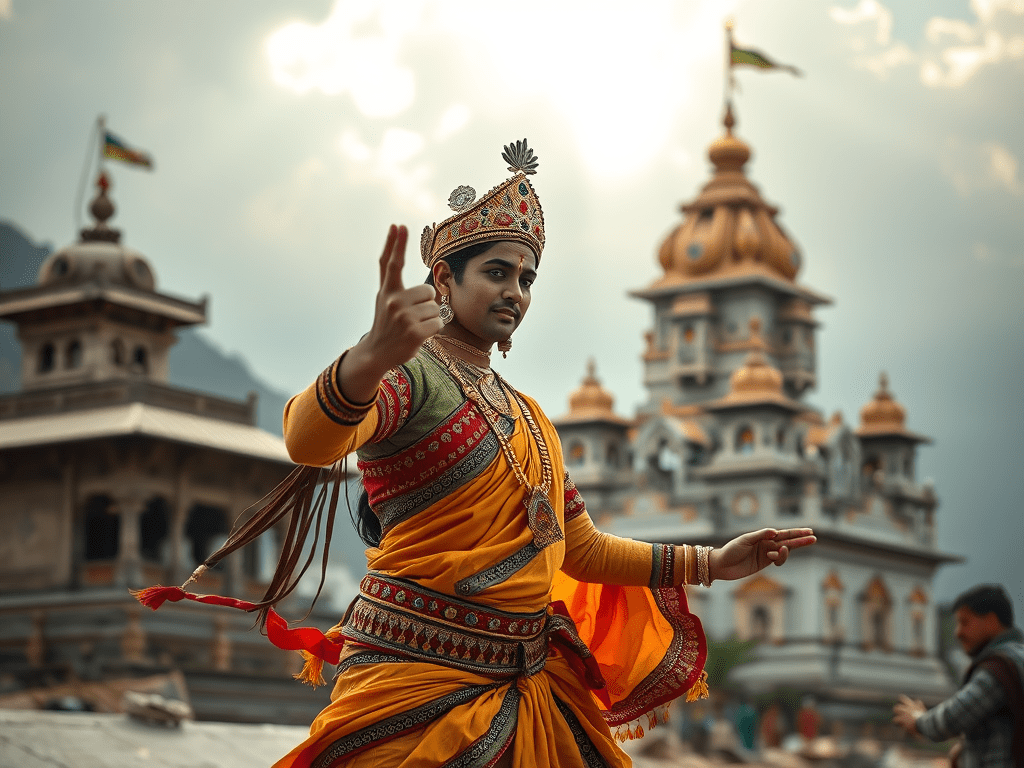
Dance, though less enduring, was a spark of joy. Chanchari’s swirling steps and claps lit festivals. Villagers in crimson shawls moved as one. Their feet drummed the earth under moonlit skies. Thadya, with its fierce gestures, mimicked gods and battles, a stage for warriors to honor Ajai’s victories. These dances, rooted in tribal rites, became Garhwal’s heartbeat, their rhythms a symbol of the unity he forged.
Crafts, subtler but vivid, adorned daily life. Weavers spun wool into shawls, their patterns swirling like rivers, dyed with madder and turmeric, each thread a quiet art. Potters molded clay into Shiva’s forms, their idols gracing home altars. Stone carvers etched temple friezes. Their tools sang as tridents took shape. Woodworkers carved doors with floral knots. Their work whispered of Garhwal’s soul. These crafts, though less central, clothed and adorned a kingdom finding its voice.
Oral literature, vital in a land without books, was Garhwal’s archive. Bards, or Bhats, wove Garhwali verses, their tongue a blend of Sanskrit and hill speech. They sang of Ajai as Shiva’s chosen, his forts rising like hymns. Legends cast him as a mystic. One tale swears that Shiva whispered in his dreams at Kedarnath. Another tale ties his triumphs to Devprayag’s sacred waters. These epics, chanted in Srinagar’s courts or village fires, were Garhwal’s mirror, reflecting a king who became myth.
Life Across Garhwal’s Tapestry
Garhwal under Ajai was a living poem, its people the verses. Farmers, the land’s pulse, toiled on terraced fields, their hands coaxing millet from rocky soil. Their homes, mud and stone, circled Devprayag’s temple. There, they offered grain and joined Jagar’s trance. Their voices rose to Shiva. Herders had faces carved by wind. They led goats along crags. Their songs blended with the river’s hum. Their nights were alive with Chanchari at village feasts.
Warriors, Ajai’s shield, honed their blades in Srinagar’s fields, their drills a dance of steel under the sun. Clad in leather, they guarded forts. They knelt at Kedarnath with their spears laid before Shiva’s shrine. Their hearts swayed to Thadya’s beat. Chieftains, once foes, now feasted in Srinagar. Their halls hung with woven rugs. Their ears were tuned to bards’ tales of Ajai’s glory. Their wives wove shawls, their fingers threading Garhwal’s pride.
Priests, keepers of the divine, chanted in Badrinath’s glow or led aartis at Devprayag, their mantras a bridge to gods. They taught yoga, echoing Ajai’s Gorakh Panthi faith, guiding villagers to breathe with the mountains. Artisans worked in Srinagar’s markets. Potters, carvers, and weavers created their crafts. Their clay lamps and stone idols were sold under banyan shade. Each creation was a spark of Garhwal’s fire.
Markets thrummed with life. In Srinagar, traders bartered wool and saffron, their stalls a kaleidoscope of color. Women, headscarves bright, shared folk songs, their baskets heavy with rice. Festivals wove the classes together. Basant Panchami draped villages in yellow, Saraswati’s hymns mingling with Chanchari’s whirl. Shivratri filled Kedarnath with fasts and Jagar, clans united in devotion. Ajai’s fair laws and parganas freed people to create, their art and faith a shield against strife.
A Legacy Eternal
Ajai Pal’s 31 years ended around 1389 CE, but his fire never faded. His kingdom stood defiant, untouched by Mughal chains. They call him the “Father of Garhwal,” for he took a land of thorns and gave it wings. In Uttarakhand today, his echo resounds: Jagar’s wail, Chanchari’s spin, Devprayag’s ancient stones. From Kedarnath’s frost to Badrinath’s light, Ajai’s art, faith, and unity sing a song that shakes the stars.


 Moon at Half Past Noon
Leave a reply to IndiaNetzone Cancel reply