Rajesh Kulkarni had planned everything down to the last paisa.
The note was written — four pages, front and back, in blue cello gripper pen, on the back of old Loksatta editorials he had been saving to line the kitchen shelf. Page one was the society committee and the terrace leakage and the four lakhs on Ganpati pandal decoration — all of it crammed together because once he started writing about the society secretary he could not stop, the way you cannot stop scratching a mosquito bite. Page two was his sister in New Jersey and the CA who smirked. Page three was half about cricket commentary and then it just stopped, mid-sentence, because he had run out of things to say and the pen was hurting his fingers. His father would have been disappointed by the lack of completeness. His father had been a schoolteacher who marked exam papers in red ink and always wrote a concluding remark, even for the failing students. Neat work but lacks preparation. Something like that.
The sturdy Nilkamal stool was positioned. The nylon rope was tied to the ceiling hook — the one meant for the summer Khus cooler. Freshly ironed white kurta he had put on, the one his mother had stitched fifteen years ago. If his corpse was going to be photographed by the Mid-Day crime reporter, shabby he would not look. A Kulkarni does not die looking like he has given up. That is the whole point of being a Kulkarni.
He climbed onto the stool. Both knees went tak-tak — the same sound they made every morning at Shivaji Park when he tried to jog and ended up walking like a man who has lost something and is pretending he is not looking for it. He adjusted the noose. One last look he took at his 1 BHK in Dadar East. Peeling paint — the society painter had promised to fix it before Diwali. Which Diwali, he had not specified. The fridge was making its usual sound, a low grinding hum that Rajesh had stopped hearing years ago. On the dining table, his blood pressure and cholesterol medication stood in two rows, breakfast and dinner, because lunch he always forgot. Next to the medication his phone was face-up, screen dark, a Zepto delivery window still open from that afternoon: one piece of ginger, twenty-three rupees, delivery fee forty, because he had been unable to meet the minimum order for free delivery no matter how many things he added and removed. In the end he had ordered nothing. Paying forty rupees to deliver a twenty-three rupee piece of ginger to a man who is going to hang himself felt, even in that moment, like an insult the universe did not earn the right to give.
He closed his eyes. Off the stool he shifted his weight. And then something sharp dug into his left calf, like a rusty compass needle.
“AAI GA!”
Back onto the Nilkamal stool Rajesh crashed, full eighty-three kilos, the stool groaning, his lower back screaming, and he grabbed the window grill and steadied himself, spectacles sideways on his face, breathing hard. A cat. Orange. Fat. Not spectacularly fat, just the regular kind of fat that comes from eating other people’s leftovers for years. On his bare foot it was sitting, staring up at him.
“Are you completely mad?” His voice cracked into that register usually reserved for auto rickshaw drivers who refuse to go by meter. “What is this? From where you have come?”
The cat blinked. One eye. Then the other.
“No, NO. That look you are giving me, stop it. In the middle of a serious thing I am, and you show up?”
The cat opened its jaw and a dead cockroach — a Dadar cockroach, the big kind, the kind that has survived multiple pest control visits — dropped onto his slipper.
“Is this a joke? I am leaving this world and you are offering me non-veg? Tuesday-Thursday vegetarian I am.”
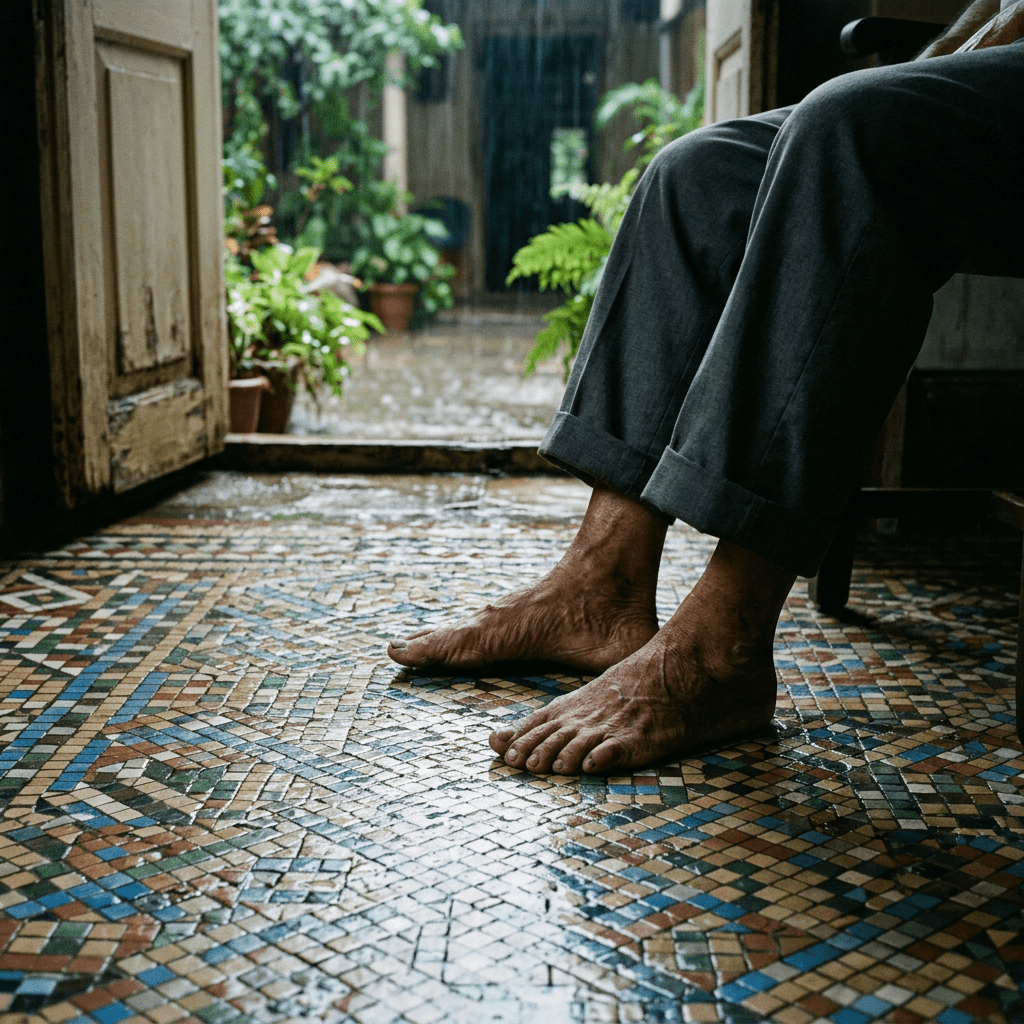
The cat sat down and began licking its left hind leg. Slowly. With no particular urgency. Off the stool Rajesh stepped carefully, because a slipped disc at fifty would mean Suresh Kulkarni from the second floor — no relation, but that never stopped him from having opinions — would have to carry him downstairs, and that satisfaction Rajesh would rather die than give him. He slipped the noose off his neck and sat flat on the cold mosaic floor, holding his knees, and the cat stared at him, and neither blinked, and Rajesh — who had once stared down a bank union leader for forty-five minutes over a chair replacement issue — lost the staring contest in approximately twelve seconds.
“Listen. Cat-vat person I am not. In our Nagpur house, a proper dog we had. Shera. Desi, but strong. During private moments he did NOT ambush people.”
The cat yawned wide, teeth yellow and slightly broken.
“Zero respect for elders. In my time, children used to stand up when elders entered the room.”
The cat stood, walked in a small circle — twice — and onto Rajesh’s lap it plonked itself, right onto his prostate, which had been sending him polite but increasingly urgent letters of complaint since 2019.
“Arre. Now bathroom I have to go.”
That night Rajesh did not die. The cat he would blame, but if honest with himself he was being — a habit he avoided with the same discipline he avoided his annual full-body checkup, the brown envelope of lab reports in the Godrej almirah’s bottom drawer behind the old income tax papers, four thousand seven hundred rupees the last one had cost, for telling him what he already knew — a loophole he had been looking for. The note had stopped mid-sentence. Even his despair couldn’t sustain itself.
He went to the bathroom, came back, and on his bed the cat was. HIS bed, the old Bombay Dyeing with the hole near the pillow he’d covered with a folded hand towel.
“Hut. Udh ja.”
The cat did not move. He said it again. The cat stretched and settled deeper. In the center of his 1 BHK Rajesh stood — fifty, unmarried, VRS money and fading fixed deposits, and now physically occupied by a fat orange cat — and sat on the edge of the bed. The cat began to purr, a low vibrating sound that traveled through the mattress and into his lower back, warm and steady, like someone pressing a hot water bag against his spine without being asked.
“Ek raat. One night.”
He fell asleep in nine minutes.
Morning with the pressure cooker whistles and the bhaji-wala outside the gate. Eyes he opened to find the cat on his chest, face two inches from his nose.
“Kaaay?”
The cat meowed — rough, scraping, like something that needed oiling.
“Yes, awake I am. Happy?”
Kitchen he shuffled to, knees popping, and put the steel vessel on for tulsi chai with turmeric, because his sister had sent a WhatsApp forward about turmeric and he didn’t believe WhatsApp forwards but he also didn’t not believe them. While the chai boiled he picked up his phone. Three notifications from Thyrocare. “🚨 Senior Citizen Full-Body Check-Up — 50% OFF!” Then: “Kulkarni ji, your annual health package is PENDING.” Then: “Don’t ignore your health! Book NOW and get FREE Vitamin D test!”
He silenced them one by one. “This lab is sending me three notifications a day. They are desperately waiting for my cholesterol to cross two hundred so they can meet their quarterly targets.”
The cat followed him to the kitchen, thudding on the mosaic. He poured Amul Taaza into the bent-rim katori from his Pune hostel days and set it down. The cat sniffed, looked up — the same look his aaji used to give the milkman when the milk was watered — and drank slowly, then cleaned its whiskers with its paw, the way his mother used to wipe the dining table after every meal, even when it was already clean.
Two weeks. Whose cat this was, he tried to find out. Tiwari the watchman laughed. “That cat answers to nobody, Kulkarni saab. Since Corona, hafta it is taking from every flat in B-wing. Children call it Biscuit.”
“Biscuit. Uncultured name.”
Biscuit he called it.
From a residential standpoint, Biscuit was non-cooperative. Every morning the crossword pen went under the sofa. The laptop keyboard got “jjjjjjjjjjjj” typed into a letter to the society secretary and sent before Rajesh could stop it. Two dead cockroaches appeared near the door over the course of a week, then nothing for four days, then a gecko — alive, deeply traumatized — which hid behind the fridge and took forty minutes to extract with a broom.
“From WHERE you have brought a gecko? Is there a form I should fill?”
Biscuit headbutted his shin and his spectacles slid down.
But here is what happens at fifty. The world quietly removes your number. Not dramatically — gradually. You start talking to whatever is in the room.
He told Biscuit about the VRS the bank was pushing. The 26-year-old manager — from some institute in Pune with a swimming pool, a swimming pool, in Rajesh’s time banking colleges had a ceiling fan and a blackboard — who had sent an invite for a “synergy alignment meeting.” In thirty years at the Maharashtra State Cooperative Bank, Rajesh had attended meetings. Plain meetings. Now this boy wanted to align synergies, which meant sitting in the same room saying things that could have been an email. The boy also used ChatGPT for everything — hey ChatGPT, suggest a team-building activity for a heterogeneous department with diverse generational value systems — and Rajesh had watched him type this and thought: I am going to be replaced by a boy who cannot write his own team-building activity.
“Unnecessarily they are inventing words. In my time, if you did work, you did work. You did not ideate or leverage. You came, you sat, you suffered, you went home.”
He told Biscuit about his father. Not all at once — it came out in pieces, over days, the way a splinter works its way to the surface. The last months in Nagpur. The Dettol smell. The night he had bathed his father and his father had said, “You have done enough, mulga,” and Rajesh had not known if it was comfort or dismissal, and two years he had been turning that sentence over in his head. Some nights he told Biscuit only this: “He used to write a concluding remark on every exam paper. Even the failing ones. I could not even finish my own note.” Some nights he told the whole thing — about the history paper in Standard IX, the red ink, the way he had read the remark over and over, turning the page to see if his father had written anything else. He hadn’t. Rajesh had been neat. He had been lacking. And his father was dead and could not write another remark, and Rajesh did not know if that was a relief or a loss. He was fifty years old and he still did not know.
And Biscuit would blink, slowly, the way it blinked at everything, and Rajesh could not tell if it was listening or not, but the talking was the thing.
He told Biscuit about Sunita tai — the woman at the kurta shop near Shivaji Park — and how she had once said, “This blue you should wear, it matches your eyes,” and how he had gone home and checked his eyes in the bathroom mirror for twenty minutes, and how the blue kurta he had never bought.
On a rainy Tuesday, on the floor he found the suicide note. Shredded. Biscuit had used it to sharpen its claws, tiny blue-inked pieces scattered with muddy paw prints. One fragment: “Society committee.” Another: “Unethical.” And half a word — “Manjre” — all that remained of his thoughts on Sanjay Manjrekar.
Biscuit was sleeping upside down on the sofa, belly exposed, paws in the air.
“If I go, who will warm the milk at six? Who will keep the fan on speed two — not speed one, not speed three, SPEED TWO?”
The left ear twitched. He gathered every piece and dropped them in the dry waste bin.
The next morning he woke up and did not think about the Nilkamal stool. That was it. One morning without the thought. Then another. Then on the third morning it came back briefly while he was making chai — he looked at the balcony cupboard — but Biscuit was sitting between him and the cupboard, a solid obstacle, and the chai was boiling over, and by the time he attended to the chai the thought had gone.
The week before Saturday was long.
Monday evening he stood in front of the bathroom mirror and held up the white kurta with the soft collar. Suresh Kulkarni had seen him in this kurta fourteen times this month. If Suresh saw him walking toward Shivaji Park at six in the evening in this kurta, walking like a man with a destination, Suresh would know. And Suresh would tell his wife. And his wife would tell the WhatsApp group. By nine o’clock the entire B-wing would know that Rajesh Kulkarni had gone to meet a woman.
He put the kurta back. Took it out again. Put it back.
Wednesday he checked Koolar’s menu on Zomato — a photo someone had uploaded sideways — and one filter coffee was one hundred and eighty rupees. Two coffees, maybe a bun maska, plus tax — four hundred rupees at least. For a meeting that might not go well. That he might sit there like an idiot, say nothing, and come home four hundred rupees lighter.
“Four hundred rupees for coffee,” he told Biscuit, who was licking its paw on the sofa. “Not even a thali. In 1995 with this much money I could have eaten at Koolar for three days.”
He did not mention that he had also tried to order ginger on Blinkit that afternoon and been stopped by the minimum order value. Two hundred rupees for free delivery. He had added ginger, green chilli, one tomato — still forty rupees short. “Who needs this many premium almond biscuits? I am one man, not a catering service.” He had closed the app and sat on the chair and looked at Biscuit and thought: I am arguing with an app about ginger. The app had won. The app always won. He wasn’t even sure he had ever won anything, except maybe that argument with the bank union leader, and the union leader had retired three years later and now ran a coaching class in Thane, which felt like a different kind of victory for the universe.
Friday night he practiced in front of the mirror. “So, Sunita tai, how is the shop going?” No. Too formal. “The weather is nice, no?” No. It was monsoon. Everything was wet. He gave up. Biscuit was on the pillow. Rajesh slept without a pillow.
Saturday. He left through the back entrance near the dustbins because Suresh Kulkarni’s evening walk was 5:45 to 6:30 and Rajesh had it memorized, not because he was tracking Suresh but because Suresh walked with the energy of a man on a mission and you needed to know his movements the way you know the train timetable — not out of interest but out of self-preservation.
He arrived at Koolar at 5:58. Sunita tai was already at a corner table. She had worn a green saree. Small gold earrings. She was reading something on her phone and her reading glasses were perched on her nose and she took them off when she saw him and folded them and put them in her purse with a single, precise motion, and Rajesh thought: this is a woman who puts things in their proper place.
“Filter coffee,” she said, before he could speak. “Two. I have already ordered.”
She had already ordered. He sat down, did it wrong, adjusted, did it again.
The coffee came. Small steel glasses, thick, strong. He wrapped his hands around one and felt the heat.
She talked about the monsoon. The awning of her shop had ripped and the landlord was not fixing it. Rajesh understood this language — the language of landlords who do not fix things — and said, “My terrace leakage, same story. Three years. Ganpati pandal they will fix first.”
She laughed. Not a big laugh. A small one, from the nose, the way people laugh when they are not trying to be funny but something is true.
“Twenty-two years,” she said, and then stopped. Stirred her coffee. “Twenty-two years I have had that shop. And now this online shopping. Meesho. Amazon. Everything is becoming app-app. My footfall has halved in two years. My brother is in Pune — he has a medical store — he says come, manage the store, I will pay you.”
She looked out the window. Rain on the glass.
“My husband left — not died, left — twenty-three years ago. Went to Bangalore. New wife. I opened the shop with the settlement money. Everyone said I was crazy, a single woman running a shop near Shivaji Park. But what to do. I knew how to fold a sari and I knew cotton.”
She paused, and Rajesh noticed the way her thumb moved across the rim of her coffee glass, a small, circular motion, like she was testing the finish of a fabric.
“Cotton speaks to you if you listen. Different weaves, different weights. The cheap stuff has a certain sound when you rustle it. The good stuff is quiet.”
“Pune is nice,” she said. Not to Rajesh. To herself, maybe. Or to the rain.
Rajesh sat with this. She might leave. This woman who had said his eyes were blue and who had already ordered the coffee before he arrived and who folded her glasses with a single precise motion and who knew the sound of good cotton — she might go to Pune and manage a medical store and he would go back to ordering one piece of ginger and not meeting the minimum order value and the cat would still need milk at six but the shop near Shivaji Park would have a new owner who did not know which shade of white suited him.
“You should not go to Pune,” he said.
It came out before he could stop it. Too direct. A bald statement with no architecture, no furniture around it. Just the raw, ugly thing itself, sitting on the table between the two coffee glasses.
Sunita tai looked at him. For a moment she didn’t say anything. Then the corner of her mouth moved — not a smile, not yet, but the possibility of one.
“You don’t even know me properly, Kulkarni saab. And you are deciding I should not go to Pune.”
“Rajesh.”
“Rajesh.” She said it slowly. “Saturday next week also. Same time. If you want.”
She picked up her purse. Took out money. Put it on the table before he could reach for his wallet.
“My treat,” she said. “You look like a man who counts his rupees. I don’t want you to suffer for two weeks over three hundred and eighty rupees.”
She left. Green saree, small gold earrings, precise steps. Rajesh sat at the table for four more minutes, the rain on the window, the empty steel glasses, the bill she had already paid.
Walking home, the route he had planned to avoid Suresh Kulkarni now felt ridiculous. Let Suresh Kulkarni see him. Let him tell his wife. Let the WhatsApp group know. Rajesh Kulkarni had sat in Koolar & Co. and a woman had told him about the sound of good cotton and he had said “you should not go to Pune” like a fool, like a man who has not spoken to a woman in eleven years, which he hadn’t, and she had said Saturday next week, and she had paid the bill, and he had not said anything interesting or charming, and his knees hurt, and it was raining.
He opened the door of his flat. Biscuit was on the sofa.
“She might go to Pune,” Rajesh said.
Biscuit’s left ear twitched.
“To manage her brother’s medical store. Twenty-two years she has had that shop. And now online shopping. Meesho. Amazon. Everything is becoming app-app. Shops are closing. And she might just… go.”
Biscuit did not respond to this. Biscuit had never ordered anything on Meesho and did not have an opinion on it.
“Saturday next week she said. Same time. But what if she goes to Pune before that? What if next Saturday I go to Koolar and the shop is closed and she is gone?”
He stood in the middle of the room, keys still in his hand, and realized he was experiencing something he had not felt in years: the specific anxiety of not wanting to lose a thing that you do not yet properly have. It was different from the anxiety of losing things you already had. This was worse. He stood there with his keys and felt stupid. A man his age. A man who should know better. And he didn’t know anything at all.
He made tulsi chai. Sat on the plastic chair. Biscuit got onto his feet, heavy and warm.
“Also, she paid the bill. Three hundred and eighty rupees. I did not even get to see the bill. She just—put the money down. Like it was nothing. Like I was a child.”
The cat shifted its weight and pressed harder against his ankles. Rajesh did not move his feet.
In the kitchen the Nilkamal stool was, where it belonged. In the balcony cupboard the nylon rope was. On the dining table two rows of medication stood, breakfast and dinner, because lunch he still forgot. His phone buzzed—Thyrocare: “Kulkarni ji, your Vitamin D is still LOW!”—and he silenced it.
“Move your fat body,” he said to Biscuit. “I need to go to the bathroom.”
Biscuit did not move.
Rajesh sat there. The chai was getting cold. Outside, the rain had stopped and somewhere a pressure cooker had started whistling, Mrs. Shukla from the fourth floor, always the first one to start cooking in the building, a woman who operated on a schedule that even the municipal corporation could not disrupt.
He sat there for another five minutes. Then five more. Biscuit’s weight on his feet. The cold chai in his hands. The thought—the Nilkamal stool thought, the rope thought—sitting in a corner of his mind like a man in a government office waiting room who has been given a token and doesn’t know if his number will ever come.
Rajesh did not know what Saturday would bring. He did not know if Sunita tai would go to Pune. He did not know if he would say something better next time or something worse. He did not know if three hundred and eighty rupees for two filter coffees was an investment or a loss.
He knew the milk needed warming in six minutes. The cat would not move until he did. The fan needed to be on speed two. The crossword pen was still under the sofa.
Six minutes.


Leave a Reply