Begin with the sea. All her stories do.
She was born within earshot of the tide, in a city that holds eleven million strangers and looks at every one of them like family. She learned early that the water keeps accounts — it takes, it gives back, it takes again, gently, like a debt collector who loves you. She will spend her whole life being that kind of city for one man. He will spend his whole life failing to notice the infrastructure.
He is not a villain. That would be easier. He is a ledger — a man who believed in salaries, punctual trains, the honest weight of groceries — and he wrote everything down except her. When he says I chose you, hear what she heard: a signature. When she says I love you, hear what he heard: a word in another language, beautiful and unnecessary. This book is the dictionary he finally learned to read by. He learned late. He learned alone. He learned from her, and she was not there.
She is reading over his shoulder as he writes this. She has already disagreed twice. He is keeping both versions. That is the marriage in one gesture — two accounts, one table.
Here is what he noticed, in the order he noticed it. The click of her bangles in a dark room, a music he counted like coins he had not earned. The purifier humming all night against the burning fields, a small sincere fan doing its best. The two-minute Sunday calls — weather, mostly, and the weather was never the point. He noticed the sound and missed the source. That is the whole failure, and it took him twenty years to write that sentence.
She did not argue with him about the sound. She argued with him about Delhi. She would not cross into it — not for films, not for weddings, not for safe hours circled on a map like exam answers. Some borders a marriage keeps for reasons it never explains. He argued with her fear for years, the way men argue with weather. He was wrong in a language he did not know he was speaking. He crossed the city once, for her, and arrived late — which is to say, on time, which is to say, late.
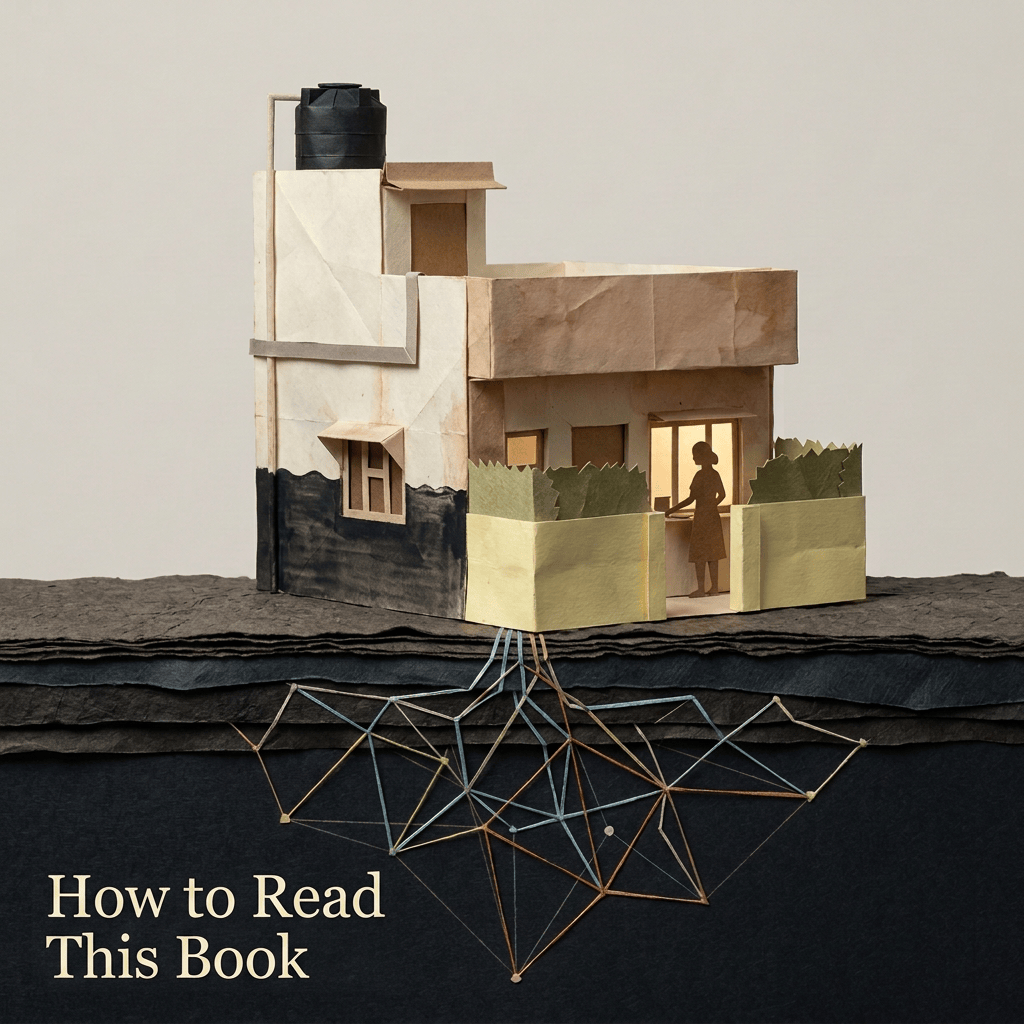
Know this about the middle of the book: it is mostly distance. Two addresses, one wire. The marriage thinned. The marriage thinned — he would have written it exactly like that, no adjective, no explanation, because he believed in the honest weight of groceries and did not believe in the honest weight of grief. But watch what happens under the floor. Some bonds do not break. They go to water table. Everything nobody remembered to water stays alive down there, and the house stands on it, crooked, standing. This is not the love that was missing. This is the bond that stayed. Do not confuse them. He did, for years. So will you, if you are not careful.
She kept accounts too. Not in a notebook — in the hedge, cut back every second Sunday so the neighbours could not see into the kitchen. In her mother’s medicines, learned by heart, dosage and hour, no errors in twenty years. In one sentence she kept for him like a roof-leak argument: tell him the tour is over.
He never heard it until it was too late to hear it, and then he heard it forever.
Tell him the tour is over.
She is reading over his shoulder as he writes this. She says: you have it wrong. I said it to myself first. For a year.
He says: I know.
She says: no you don’t. You are putting it here because it is a good line.
He keeps it anyway.
When the words finally come, they will come from him. They will be late. They will be the wrong flowers. She will forgive them — yearly, the way you forgive a season for arriving at all.
This is a book of seasons because she is a book of seasons, and he learned them one at a time, in the wrong order, from too far away. Spring in a pickle jar of chillies. Summer on a flight north, her palm flat to the window as the sea became a rumor. Monsoon on two roofs at once — hers drumming, his leaking exactly where he said it wouldn’t. Autumn, invented by two people who had never been told it was autumn. Winter, the only honest season, telling each city what it’s made of, and both of them listening, in different time zones, to the same report.
Read slowly. She did everything slowly — completely, in full view, no shame. He is asking, now, at the end of the book and the beginning of everything, that you do the same.
She is reading over his shoulder as he writes this.
She says: the last line should be mine.
It is.


Leave a comment