I
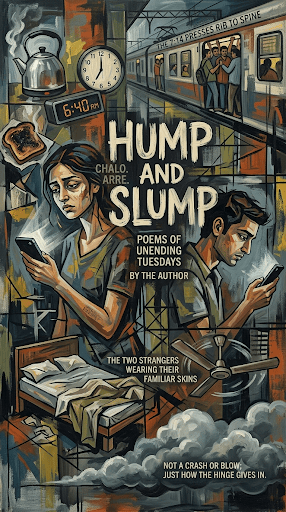
Six-forty.
The cooker does its usual scream.
The milk has formed its skin.
The bread is charred.
She scrolls the feed. He scrolls the same cold stream
of other people’s Tuesdays, faintly starred
with envy, then forgotten.
Chalo, we’re late.
The local train holds its breath for no one’s sake.
They part. They meet. They part. They replicate
the day’s small dying. One more. Then awake.
II
The 7:14 still presses rib to spine.
The oranges still wait in their bright queue.
He buys the same ones. She says, These are fine,
which means: I have stopped looking. Half-past two
dissolves to six.
They ride through traffic’s hell,
his hand not at her back, her gaze not his,
each scrolling through the day they will not tell,
each almost asking what the other is.
III
And then the lights go out. And then the bed.
And then the old choreography begins—
a script they have memorized but never read,
two strangers wearing their familiar skins.
He knows the angle. She knows when to sigh.
They move like commuters who have missed their stop
but ride the train anyway, too tired to try
the door, too far from home to simply hop.
No trembling here. No trembling and no fire.
The trembling was for children and for fools.
This is the hump: the body’s blunt desire
to be a body, following the rules.
Essential as the tap that runs by eight.
Unsavory as milk left in the heat.
They do not kiss. They do not separate.
They do not speak. They do not miss a beat.
IV
Afterward, the ceiling. Afterward, the fan.
The sheet.
The separate pools of sweat. The dark
that lies down between them like a man
who pays the rent and never leaves a mark.
They do not touch. They do not need to touch.
The touching was the point. The touching went.
The touching, it turns out, was not so much
a language as a habit. Spent. And spent.
And yet—and yet—she does not leave. He stays.
The cooker will whistle at six-forty.
The bread will burn. The traffic will not praise
their quiet endurance. Staring blank and free,
they buy the same round fruit.
Habit will take
the shape of hope that grew too thick and fat
to ever dream of leaving or awake.
Chalo, she’ll say. Arre, he’ll say. And that
will be the whole of it. The linen crease.
The weekday clock that never will remit.
No truce declared, and yet a kind of peace:
the mortal room, the body used to it.
V
She does not pray. He does not pray. Too tired for a wish or a complain.
They keep the fan on. In the dark, the ceiling turns
its slow perhaps, perhaps.
The city’s deep
and diesel churn continues.
Nothing learns.
Nothing changes. The trains will run. The taps
will run. The days will run. The love—if love—
will find a smaller way.
Two words. Perhaps
the whole of it: Chalo. Arre.
Above the roof, monsoon gathers like a debt.
Below, the chawl curses in its seven tongues.
The kettle will not ask. The fan will not
forgive. The bread will burn. The iron lungs
of trains will gasp. And they will rise, and get
dressed in the dark, and eat, and lie, and let
the night divide them.
Not a crash or blow;
just how the hinge gives in. The undertow.
The hump. The slump. The Tuesday. The adjust.


Leave a comment