
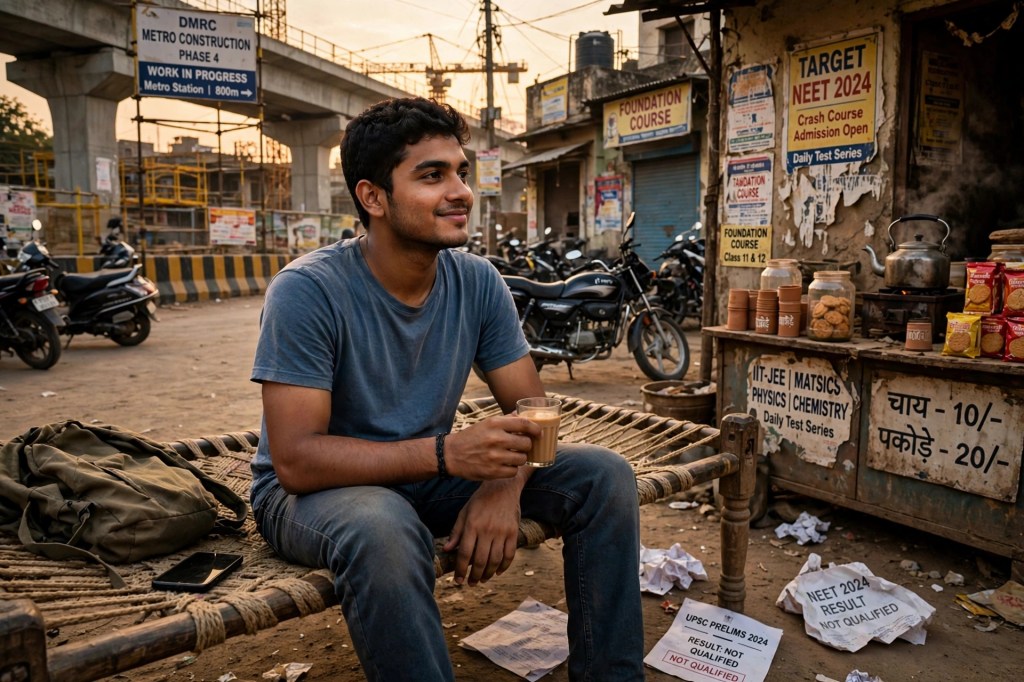
The bypass road does not care who clears the list.
Six flyovers climb from the mustard fields,
piers wrapped in burlap, wet with curing-slurry,
stamped in yellow stencil: C-4: Passed.
Under the ramp, three coaching centers share a generator.
Two hundred plastic stools cram the basement floor,
facing a board that reeks of spirits.
Formulas for shear and fluid flow,
the cut-off marks for general quota
scratched into ply with compass points.
Every boy wears the same blue lanyard;
every boy’s mother tied a cord around his wrist—
red thread, soaked in temple oil,
turned gray against the cuff.
They memorize the yield of steel
to sit in air-cooled rooms in Pune
and clear the bills for German gearboxes.
I walked out through the wicket gate at three.
My roll number was missing from the third sheet;
it was not in the corrigendum.
On the curb, a father split an envelope
with a thumb that shook,
spilling verified copies of caste claims in the gutter sludge.
My phone went off in my pocket—
dry, blunt pulses against the bone.
My mother, calling from the tehsil town,
keeping the brass lamp lit since dawn
before the framed print of Hanuman,
the front room full of uncles by now,
waiting on the four numbers of the rank.
The first five minutes are pure gorge.
The spit goes thin and sour behind the teeth;
tar-heat comes off the lane straight to the eyes,
and you smell the mortgage on the four bighas—
compound interest chewing the field row by row.
You want the deck of the flyover
to drop its concrete slab squarely on your skull:
a clean break,
an honest accident to kill an average score.
Then the phone went black.
The red bar thinned, flickered, died.
The glass went flat and dark,
catching only a stripe of bleached sky and a slack wire.
Right there, the shame ran out of breath.
The dread had a ceiling, and I struck it.
The worst thing due our house had struck,
and the tarmac did not tear open for the tea stall.
The boy dropping dough in burnt cottonseed oil
never looked up from the pan.
The exhaust still tasted of iron and sulfur.
My knees, which were wet cardboard,
went cold, went hard, went empty.
To fail this hard—past re-checks, past review—
is to drop clean off the municipal roll.
You slip below the notice of the state.
No bank clerk looks across his desk to check your file;
matchmakers strike your mother’s lane off their routes;
the turnstile at the tech park will never trip for your thumb.
You drop beneath the ink of the magistrate.
Ahead, the evening shift begins to clog.
White hatchbacks, bumper to bumper, air vents humming,
pack the lanes with men who scored ninety-four and up.
They sit with ID cards tucked flat into their shirts,
staring into the red taillights ahead,
eyes stinging behind anti-glare glass,
wondering if the yearly raise will clear the nursery deposit,
wondering what the liver panel will show on the company scan.
They have bought the right to be measured till they die.
I took the broken curbstone near the ditch.
A yellow backhoe idled in the muck,
its shovel grounded in the clay,
dripping black hydraulic oil into the weeds.
The boy brought tea in a chipped tumbler.
I had twelve rupees in coins and nowhere I had to stand.
The string on my wrist had frayed to two dry hairs;
I caught the knot and snapped it,
and let it drop in the soot between my chappals.
The sun dropped down behind the brick kilns,
dull, copper-burnt, answering to no one.
The trucks threw their long yellow beams through the coal dust,
running rebar to cities I will never have to pour.
I drank the tea while it was hot.
Nobody was looking.


Leave a Reply